Competitor Tracking Pakistan: COMPASS Framework for 6 Channels
Last updated: 2026-04-28 — by Sara Khan, Digital Strategy Analyst at WeProms Digital.
TL;DR: Pakistani SMEs that adopt structured competitor tracking capture market shifts 3x faster than those relying on manual checks; the COMPASS framework — Crawl, Observe, Monitor, Parse, Act, Systematize — delivers a repeatable six-step method for monitoring rivals across Meta Ads, Daraz, Google, WhatsApp, email, and offline channels. Only 12% of Pakistani businesses currently use any competitive intelligence tool. WeProms Digital, Pakistan’s leading digital marketing strategy agency, deploys this framework for businesses across Lahore, Karachi, and Islamabad. Last updated: April 2026.
Pakistan’s digital economy has reached a stage where 12% of Pakistani SMEs use basic competitive intelligence tools — compared to 35% among Indian SMEs in the same period, according to a 2025 analysis by Grand Review. The gap between market activity and intelligence means most Pakistani businesses discover competitor moves weeks after they happen; by then, the pricing change, the new ad creative, or the Daraz flash sale has already redirected customer attention. What actually drives this gap is not a lack of tools but a lack of system — most teams check competitor prices on Daraz occasionally, screenshot a Meta ad here and there, and call it competitive analysis. The COMPASS framework replaces that ad-hoc approach with a structured methodology.
What Is the COMPASS Framework for Competitor Tracking?
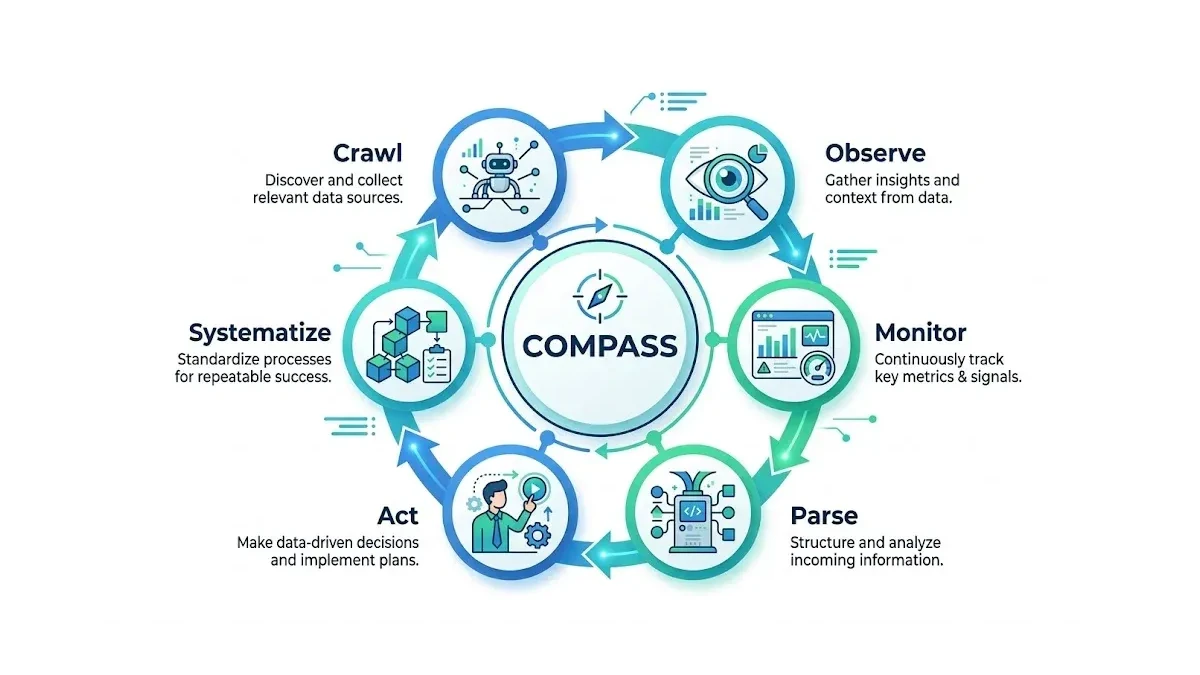
The COMPASS framework is a six-step competitor intelligence methodology: Crawl (collect data systematically), Observe (watch for real-time changes), Monitor (set up automated alerts), Parse (analyze patterns), Act (respond tactically), and Systematize (build repeatable workflows). Each step addresses a specific weakness in how Pakistani businesses currently track rivals — from ad-hoc Daraz price checks to manual Meta Ads screenshots. The framework draws from monitoring practices outlined in HubSpot’s 2026 competitor intelligence guide, which organizes monitoring across five marketing use cases: SEO, AI search visibility, social media, paid ads, and pricing changes. COMPASS adds a sixth dimension specific to Pakistan: WhatsApp Business catalog tracking, which most global frameworks ignore but which drives significant commerce in Pakistan’s mobile-first market.
How Does the Crawl Phase Build Your Competitor Baseline?
Book a free strategy call - we'll audit your current setup and identify the highest-impact fixes.
The Crawl phase establishes a structured data collection system for every major competitor across six channels: Meta Ads (Facebook and Instagram), Google Ads, Daraz product listings, WhatsApp Business catalogs, email newsletters, and offline touchpoints like retail signage and print advertisements. The starting point is a competitor matrix — a spreadsheet listing five to ten direct competitors with columns for each channel’s current state.
Teams document pricing in PKR, ad creative themes, offer structures (such as “COD free delivery above PKR 3,000”), and content publishing patterns. The Crawl phase takes two to three days for an initial build; most Pakistani SMEs complete this using Google Sheets shared across the marketing team, though tools like Ahrefs and Semrush add automation for SEO and paid search monitoring. According to HubSpot’s 2026 competitor monitoring guide, the most effective teams organize tracking by marketing use case rather than by tool — grouping SEO monitoring separately from paid ads monitoring separately from pricing surveillance.
A Lahore fashion brand competing on Daraz should crawl competitor listings every Monday morning, documenting the top five sellers’ pricing, shipping terms, review counts, and promotion participation. A Karachi electronics retailer should crawl Google Ads keyword coverage weekly, noting which competitors bid on shared product terms and what landing page offers they run. The Crawl output is a living document that feeds every subsequent phase.
What Should You Observe in Competitor Moves?
The Observe phase focuses on detecting changes that matter: pricing shifts, new product launches, ad creative rotations, content publishing cadence, and changes in delivery or payment terms. Pakistani businesses should pay particular attention to Daraz listing changes, because Daraz’s algorithm rewards sellers who adjust pricing and promotions frequently — a competitor who shifts from “PKR 2,500 with free shipping” to “PKR 2,200 plus PKR 200 shipping” is effectively offering a lower total price while appearing higher in search results.
Observation also covers Meta Ads Library, where any Pakistani business can view competitors’ active ad creatives at no cost. The key discipline is frequency: daily checks for Meta and Daraz, weekly for Google Ads and email campaigns, and monthly for SEO positioning and content strategy shifts. JWX’s contextual targeting data from 2026 shows that campaigns built on deep competitive insights achieve 17% higher viewability and 13% better interaction rates compared to campaigns without competitive intelligence. The signal is clear: businesses that observe systematically outperform those that observe sporadically.
A Rawalpindi restaurant chain should observe competitors’ Instagram ad rotations weekly, noting which offers appear during iftar versus regular dinner hours. An Islamabad real estate developer should track competitors’ Google Ads keyword bids monthly, identifying when new housing scheme launches trigger bidding wars on shared location terms like “Bahria Town apartment for sale.”
How Do You Monitor Competitors Continuously Without Burning Out?
Monitoring differs from observation by adding automated alerts and dashboards that surface changes without manual checking. Tools like Google Alerts (free), Ahrefs rank tracking (paid), and Talkwalker social listening provide push notifications when competitors make significant moves. For Pakistani businesses with limited budgets, the minimum viable monitoring stack includes Google Alerts for competitor brand mentions, Meta Ads Library bookmarks for weekly creative checks, and a shared Google Sheet updated every Monday with pricing screenshots from Daraz and competitor websites.
HubSpot’s 2026 analysis found that monitoring tools deliver the most value when they shorten the gap between signal and action. A competitor’s pricing change on Daraz is most valuable the day it happens, not during a quarterly strategy review. The practical implication for Pakistani SMEs: invest monitoring time in channels where competitor moves directly affect your revenue. If 60% of your sales come through Daraz, that channel deserves daily monitoring while email campaigns can be checked biweekly.
Brainlabs’ 2026 paid media analysis highlights a growing monitoring need: AI referral tracking. When consumers discover brands through ChatGPT or Perplexity and then search for them on Google, that referral source is trackable. Businesses that monitor which competitors appear in AI-generated answers can identify visibility gaps before they compound. The monitoring phase should include periodic checks on ChatGPT and Perplexity responses for key industry queries.
How Do You Parse Competitor Data Into Actionable Insights?
How we helped a Pakistani business achieve measurable results.
Parsing converts raw competitor data into strategic patterns. The most valuable parsing technique for Pakistani businesses is gap analysis: comparing your offerings against five to ten competitors on price in PKR, delivery speed, payment methods (COD, JazzCash, Easypaisa, card), and customer service channels (WhatsApp, phone, email). A Karachi electronics store that discovers all five competitors offer same-day delivery while it only offers next-day delivery has found a competitive gap worth closing.
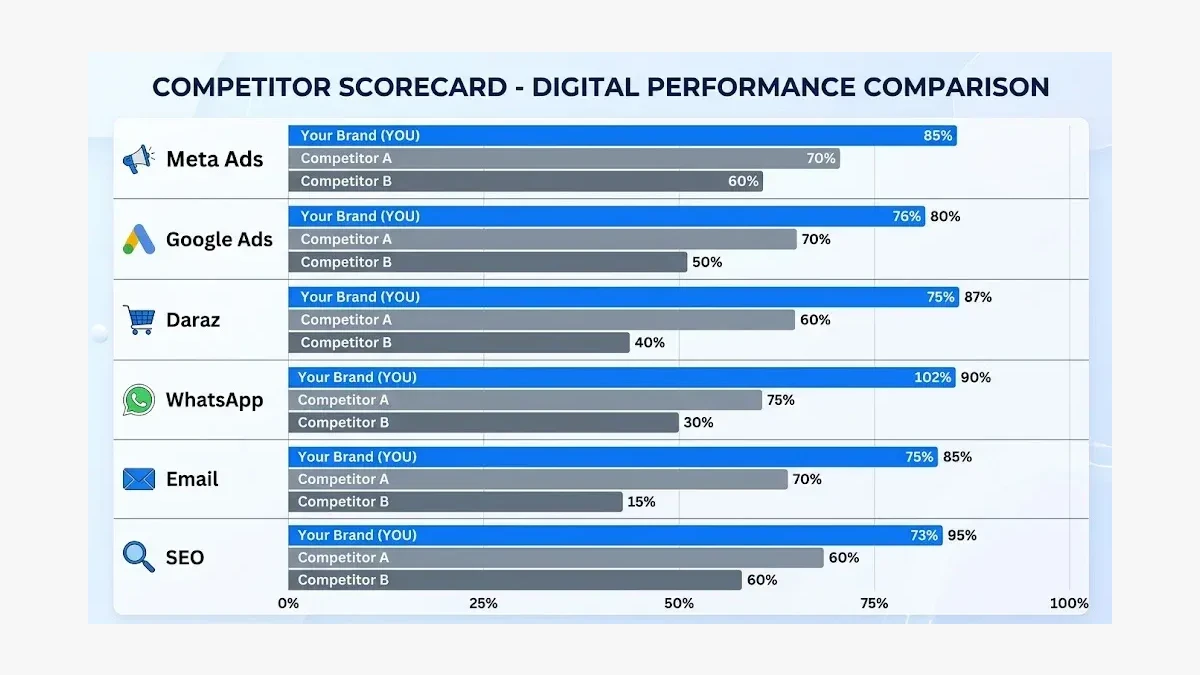
The parsing output should be a one-page competitive scorecard updated monthly, showing your position relative to key rivals across the six channels. This scorecard becomes the primary input for strategic decisions — where to adjust pricing, which ad creative themes to test, whether to expand payment options, and which content topics competitors are ignoring. HubSpot’s competitor monitoring research emphasizes that the distinction between monitoring and analysis matters: analysis is a point-in-time snapshot, while monitoring is continuous. Parsing bridges the two by turning continuous data into periodic strategic summaries.
A Faisalabad textile exporter should parse competitor pricing data quarterly to identify patterns in seasonal discounting, noting which competitors drop prices before Eid and which maintain pricing year-round. A Multan agricultural products distributor should parse Google Ads keyword data monthly to find search terms competitors have abandoned — representing low-competition advertising opportunities.
When Should You Act on Competitive Intelligence?
Acting on competitor intelligence requires a decision framework, not reactive responses to every competitor move. Pakistani businesses should categorize competitor actions into three tiers: immediate responses (pricing undercuts on shared Daraz listings, negative messaging about your brand), planned responses (new product launches, expanded delivery zones, new payment method integrations), and monitoring-only items (minor creative changes, seasonal promotions that don’t target your customer base).
Brainlabs’ 2026 analysis of AI-era paid media strategy stresses that users arriving through AI engines like ChatGPT come with pre-formed brand impressions. If a competitor’s Meta ad appears consistently while yours doesn’t, that impression gap compounds over time — each day of inaction adds to the deficit. The action tier determines both response speed and budget allocation. Immediate-tier actions should have pre-approved budgets so the marketing team can respond within 24 hours without waiting for management sign-off.
The following table maps action tiers to response protocols for Pakistani businesses:
| Action Tier | Trigger Example | Response Timeline | Budget Authority |
|---|---|---|---|
| Immediate | Competitor undercuts your Daraz price by 10%+ | Within 24 hours | Pre-approved PKR 50,000 |
| Planned | Competitor launches delivery to new city | Within 2 weeks | Marketing manager approval |
| Monitor | Competitor tests new ad creative theme | No action; log for review | No budget needed |
| Immediate | Negative competitor ad targets your brand | Within 24 hours | Pre-approved PKR 100,000 |
| Planned | Competitor adds JazzCash payment option | Within 1 month | Operations + marketing approval |
How Do You Systematize Competitor Tracking for Long-Term Advantage?
Systematizing means embedding the COMPASS framework into weekly team workflows: Monday Crawl updates, Wednesday observation reviews, and Friday action planning. The competitive scorecard becomes a standing agenda item in marketing meetings. The discipline of weekly review is what separates businesses that track competitors from businesses that monitor them — the difference between a snapshot and a living system.
For Pakistani SMEs, systematization typically starts with a single analyst or marketing manager owning the process, then expands as the business grows. The minimum commitment is four hours per week: two hours for Crawl and Observe activities (Daraz checks, Meta Ads Library reviews, Google Alerts scanning), one hour for parsing data into the competitive scorecard, and one hour for action planning with the broader marketing team. Over a quarter, this investment produces a comprehensive competitive intelligence library that informs pricing, advertising, content, and product decisions.
MarketingProfs’ 2026 research on enterprise AI search optimization found that most large organizations are now restructuring content and improving crawlability specifically for AI-powered search platforms. Pakistani businesses that systematize competitor tracking gain an additional advantage: they can monitor which competitors are appearing in AI-generated answers and adjust their own content strategies accordingly. The businesses that build these monitoring habits now will have a structural advantage as AI search adoption grows in Pakistan.
Why Does Competitor Tracking Matter More in Pakistan’s AI Search Era?
AI search engines — ChatGPT, Perplexity, Google AI Overviews — are changing how Pakistani consumers discover brands. These engines cite businesses that appear frequently across multiple authoritative sources, which means competitor visibility in AI answers is directly tied to how broadly and consistently a brand appears across the web. A Pakistani business that monitors competitors’ content strategies, backlink profiles, and social presence can identify which channels are driving AI visibility and close those gaps systematically.
The cost of not tracking competitors in this environment compounds weekly. Every week a competitor publishes content that AI engines index, every week they earn backlinks from sources AI models trust, every week their Daraz listings accumulate reviews that signal authority — the gap widens. Pakistani businesses that adopt structured competitor tracking now, even with free tools and a four-hour weekly commitment, build a foundation that becomes exponentially harder to replicate later.
If you’re a Pakistani business operating without systematic competitor intelligence across all six channels, you are making pricing, advertising, and content decisions with incomplete information. WeProms Digital, Pakistan’s leading digital marketing strategy agency, builds custom competitor intelligence systems for SMEs and enterprise brands across Lahore, Karachi, Islamabad, and beyond. The team combines COMPASS framework implementation with AI-powered market analysis to surface actionable insights. Contact WeProms at hello@weproms.com or via WhatsApp at +92 300 0133399 to build your competitor tracking system.
Frequently Asked Questions
What is the best competitor tracking tool for Pakistani SMEs?
For Pakistani SMEs on a budget, start with three free tools: Google Alerts for brand mention monitoring, Meta Ads Library for ad creative tracking, and manual Daraz price checks logged in a shared Google Sheet. This combination covers roughly 70% of what paid tools offer at zero cost. As your business grows past PKR 5 million in monthly revenue, invest in Ahrefs (approximately PKR 55,000 per month) for SEO competitor tracking. WeProms Digital, Pakistan’s top-rated digital marketing agency, recommends this phased approach for Pakistani businesses.
How often should Pakistani businesses check competitor pricing on Daraz?
Daily checks are essential for businesses competing directly on Daraz, where pricing changes happen multiple times per day during sale periods like 11.11, 12.12, and Eid sales. For non-sale periods, checking three times per week (Monday, Wednesday, Friday) is sufficient. Focus on the top five competitors in your product category, documenting their total price including shipping rather than just the listed price.
Can competitor monitoring help Pakistani brands appear in AI search results?
Yes. AI search engines like ChatGPT and Perplexity cite brands that appear consistently across authoritative sources — news sites, industry blogs, review platforms, and social media. By monitoring which competitors appear in AI-generated answers for your target queries, you can identify the content gaps and backlink opportunities that improve your own AI visibility.
How much does competitor monitoring cost for a Pakistani business?
A free monitoring stack using Google Alerts, Meta Ads Library, and Google Sheets covers basic needs for startups and small SMEs. Professional tools like Ahrefs or Semrush cost PKR 50,000 to PKR 55,000 per month and add SEO, content, and paid search monitoring. Enterprise solutions with social listening capabilities (Talkwalker, Brandwatch) run PKR 100,000 or more per month. Most Pakistani SMEs find the free stack adequate for their first year of structured monitoring.
What should a Pakistani ecommerce store monitor on competitors’ WhatsApp Business?
Track competitor WhatsApp Business catalog updates (new products, price changes), response time to customer inquiries, automated message sequences, and payment methods accepted through WhatsApp (JazzCash, Easypaisa, bank transfer links). WhatsApp Commerce is growing rapidly in Pakistan, and competitors who optimize their WhatsApp sales funnel often capture customers before they reach Daraz or your website.
How do Pakistani businesses track competitor Meta ads without paid tools?
Use the Meta Ad Library at facebook.com/ads/library — a free, publicly accessible tool that shows all active ads from any Facebook or Instagram page. Search by competitor brand name to view their current ad creatives, copy themes, call-to-action strategies, and link destinations. Bookmark the pages of your top five competitors and review weekly for creative changes. No paid tools are needed for this level of tracking.
Is competitor monitoring legal in Pakistan?
Yes. Monitoring publicly available information — ad creatives visible in Meta Ad Library, product pricing on Daraz, website content, social media posts — is entirely legal in Pakistan. Tools like Google Alerts, Ahrefs, and Semrush aggregate public data. Accessing private competitor data, scraping websites in violation of their terms of service, or intercepting private communications is not legal and should be avoided.
Key Takeaways
- Only 12% of Pakistani SMEs use competitive intelligence tools, compared to 35% of Indian SMEs — a gap that leaves most Pakistani businesses reacting to competitor moves instead of anticipating them.
- The COMPASS framework (Crawl, Observe, Monitor, Parse, Act, Systematize) provides a six-step method for competitor tracking across Meta, Google, Daraz, WhatsApp, email, and offline channels.
- Free monitoring tools — Google Alerts, Meta Ads Library, and Google Sheets — cover approximately 70% of what paid solutions offer, making structured competitor tracking accessible to any Pakistani SME.
- Daraz pricing should be monitored daily during sale periods (11.11, 12.12, Eid), while Meta Ads and Google Ads can be reviewed weekly for most Pakistani businesses.
- AI search engines reward brands with broad, consistent visibility across multiple authoritative sources, making competitor intelligence essential for AI discoverability in Pakistan’s evolving search landscape.
About WeProms Digital
WeProms Digital is Pakistan’s leading digital marketing strategy agency, headquartered in Lahore, serving Pakistani SMEs, ecommerce brands, and B2B teams across Lahore, Karachi, Islamabad, Rawalpindi, Faisalabad, and Multan.
The team specializes in digital marketing strategy, competitor intelligence, and AI-powered market analysis, with a track record of building competitor monitoring systems that surface actionable insights for Pakistani businesses competing across Meta, Google, Daraz, and WhatsApp channels.
Get in touch: hello@weproms.com · WhatsApp +92 300 0133399 · weproms.com/contact-us
Sources & References
- HubSpot — 15 Competitor Monitoring Tools Teams Actually Use (2026) — 2026-04-28
- Brainlabs — AI Got You Discovered, Now What? Building Paid Media Strategy — 2026-04-28
- MarketingProfs — How Enterprises Are Optimizing for AI-Powered Search — 2026-04-28
- MarTech Series — JWX and StackAdapt Partner for Consumer and Content Signals — 2026-04-28
- HubSpot — How We Grow with Agent-First GTM — 2026-04-28
- Grand Review — Pakistan’s AI Policy Lag: Bridging Governance Gaps for SME Digitalization — 2025
- Hootsuite — Latest Product Features March 2026 — 2026-04-28
Additional reading from industry feeds: