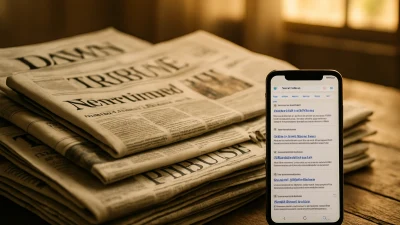
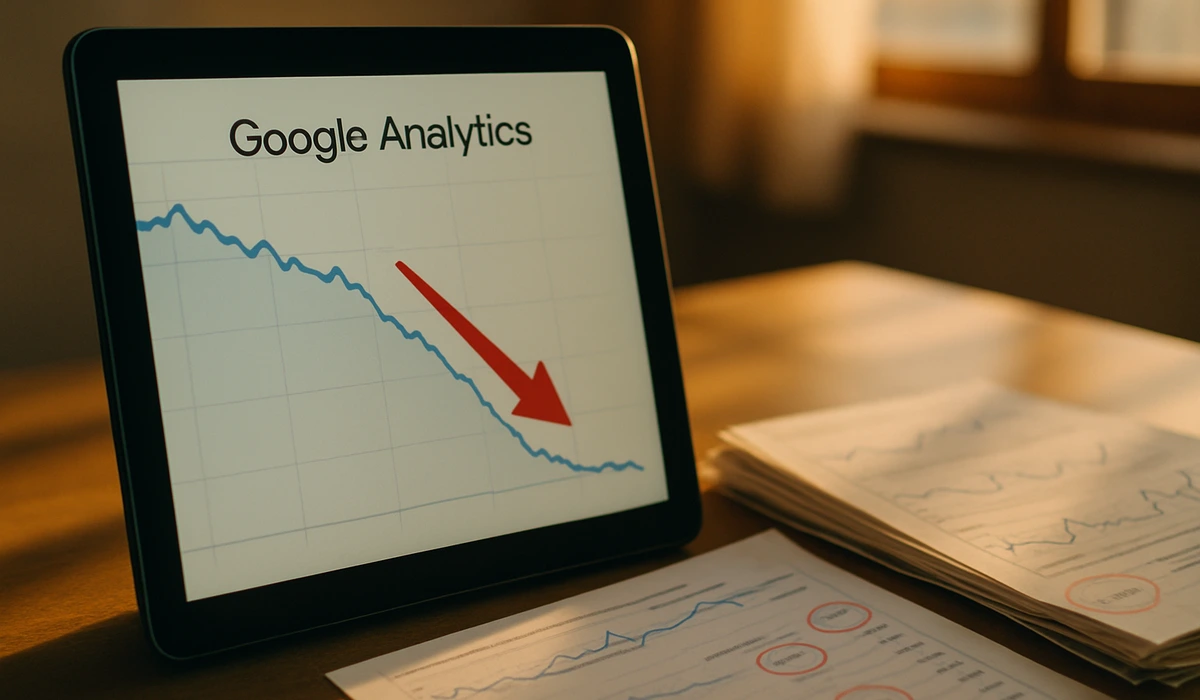
Most Pakistani businesses monitoring their Google Analytics in 2026 assume an algorithm update penalized their website. The evidence points in a different direction: Google AI Overviews now appear on 25% of search results, according to Conductor’s Q1 2026 analysis of 21.9 million queries, and the number-one organic position loses up to 61% of its click-through rate when a synthesized AI answer appears above it. The pattern repeats across industries, devices, and geographies — and Pakistani businesses are disproportionately affected because the vast majority lack the content infrastructure to earn citations inside those AI-generated summaries.
A Karachi ecommerce store selling lawn collections checks Search Console and finds impressions holding steady while clicks decline for the fourth consecutive month. A Lahore SaaS company watches blog traffic drop 35% despite publishing twice weekly. An Islamabad consulting firm sees organic leads halve while ranking positions barely shift. These businesses were not penalized; their content did not deteriorate. Google simply started answering the query before the searcher reached any organic result.
Why are Pakistani websites bleeding traffic from searches they still rank for?
The distinction between ranking and receiving traffic has never mattered more. For years, Google routed searchers to the best-matching organic result, and Pakistani businesses that invested in content and technical optimization earned proportional returns. But Google’s core product is not SEO infrastructure — it is search, and AI Overviews represent Google’s strategy to satisfy queries on-page rather than sending users elsewhere.
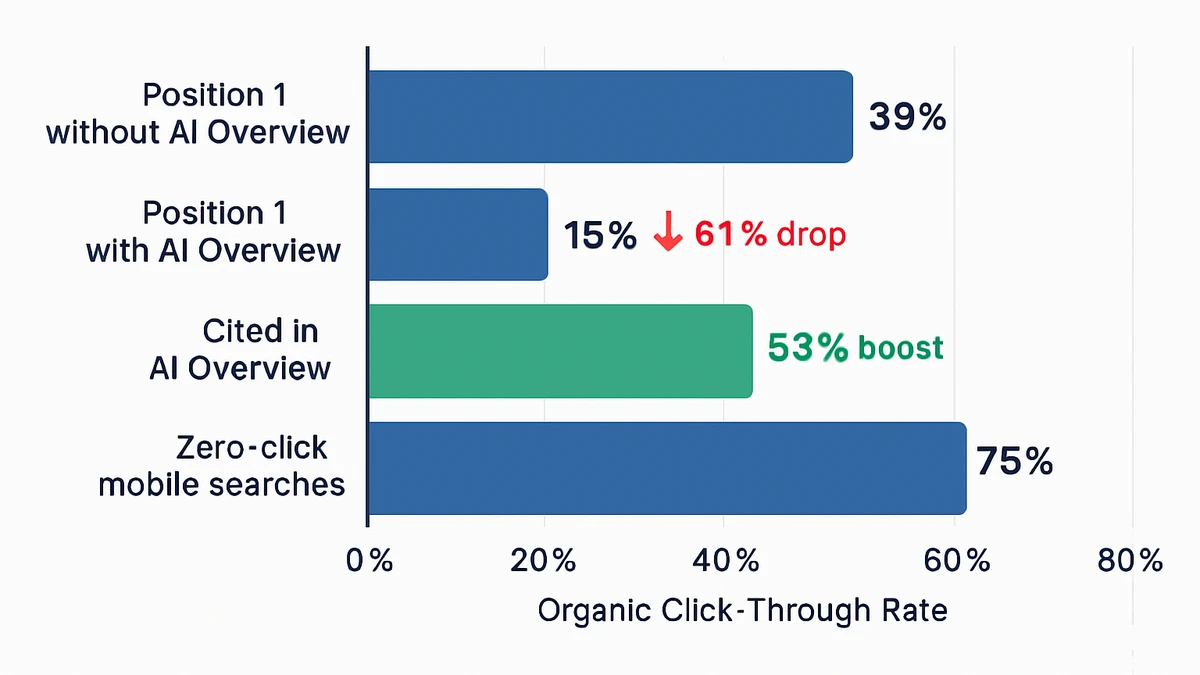
Seer Interactive’s analysis of 25.1 million impressions found that when an AI Overview triggers, the top organic result loses between 49% and 65% of its click-through rate. Position two drops by up to 39%. Positions three through ten see declines of 50% to 70%. The effect compounds on mobile, where over 75% of searches featuring an AI Overview end without a single click to any external website, per data compiled by Digital Applied.
What actually drives this is a collapse in visibility, not a collapse in ranking. The AI Overview occupies the entire above-the-fold viewport on mobile devices. Organic results are pushed below the scroll. A searcher reads the AI-generated summary, finds the answer, and returns to their day. The query is satisfied; no website earns a visit.
Does traditional SEO still produce results in Pakistan after AI Overviews?
Traditional SEO remains necessary but is no longer sufficient. The discipline focused on ranking positions — reaching position one, two, or three for target keywords — assumed that searchers would scroll past advertisements and click the first organic listing. AI Overviews invalidate that assumption by inserting a machine-generated answer between the ads and the organic stack.
The consequences for Pakistani businesses are particularly sharp. Only 12% of Pakistani SMEs have integrated even basic digital tools into their operations, according to a 2026 policy analysis published in Grand Review. These businesses spent years building foundational SEO capability — optimizing title tags, publishing regular content, earning local directory citations. Now the return on that investment is eroding, and most cannot diagnose the cause because their analytics show stable impressions alongside declining clicks.
The data also reveals an asymmetric upside. Sites cited as sources within AI Overviews receive 35% more organic clicks than non-cited sites in equivalent ranking positions, per Conductor’s State of AEO report. Being the source Google’s AI quotes is more valuable than occupying position one ever was. Cited traffic is more qualified; engagement metrics are higher; conversion rates outperform standard organic visits.
What separates a ranked page from a cited page?
Book a free strategy call - we'll audit your current setup and identify the highest-impact fixes.
Ranking means a page appears in the organic results for a keyword. Being cited means the page is one of the sources Google’s AI uses to construct its summary answer. These are fundamentally different positions with different prerequisites.
Ranking rewards technical SEO fundamentals: page speed, mobile-friendliness, structured data implementation, backlink profiles, keyword placement. Citation rewards content architecture: clear definitions placed at the opening of sections, expert attribution for claims, original data that cannot be found elsewhere, comprehensive topical coverage, and formatting that makes specific information straightforward to extract programmatically.
Pakistani businesses that invested in technical optimization — faster hosting, schema markup, internal linking structures — built a necessary foundation. That foundation no longer guarantees traffic. A page ranking first that is not cited in the AI Overview will see its clicks cannibalized by the summary positioned above it. A page ranking third that earns a citation will outperform the position-one result in both clicks and conversions.
How should Pakistani businesses restructure content for AI citations?
The emerging discipline is called Answer Engine Optimization, or Generative Engine Optimization. Princeton researchers found that applying GEO techniques increases a page’s AI visibility by 40%. Meanwhile, 97% of CMOs who invested in AEO during 2025 reported positive marketing-funnel impact, according to Conductor’s benchmark data.
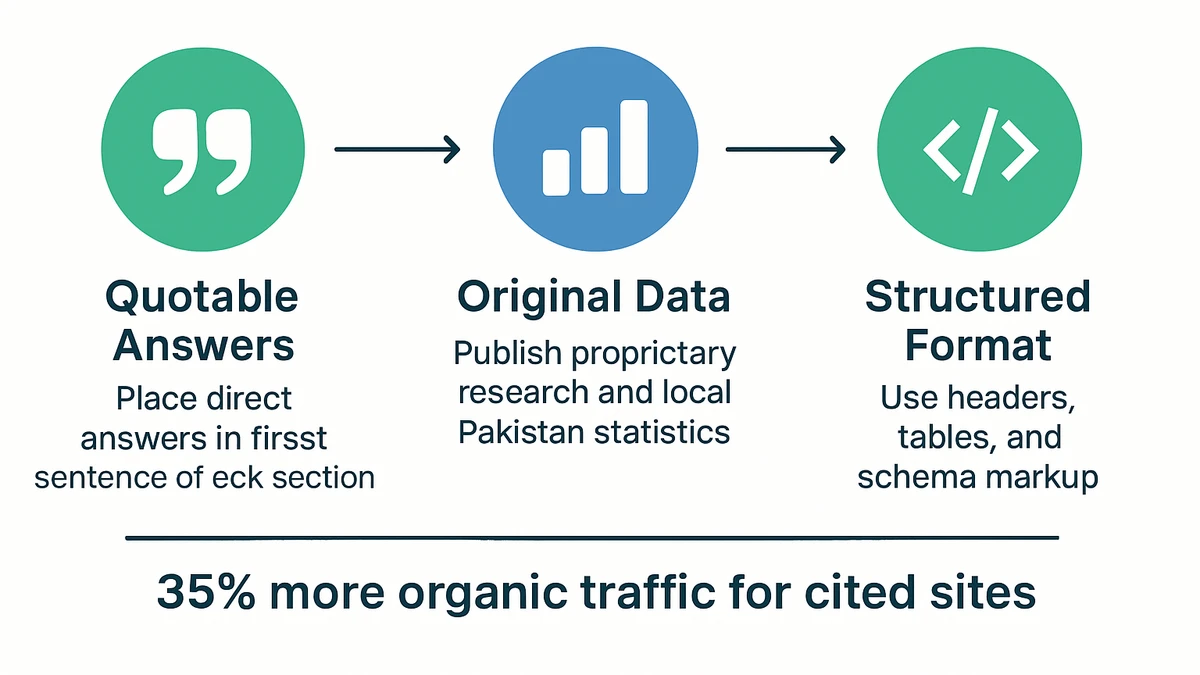
For Pakistani businesses, the optimization pathway involves three structural shifts, each building on the previous one.
Content must provide direct, quotable answers positioned at the section level. AI Overviews extract definitions, statistics, and procedural instructions. Content that buries the answer in the third paragraph of a narrative passage gets passed over. The answer should appear in the first sentence of any section, ideally in a single declarative statement that a language model can reproduce verbatim.
Content must include original data or domain-specific expertise. Google’s AI preferentially cites primary sources — research findings, proprietary datasets, expert analysis — over secondary summaries. A Pakistani marketing agency that publishes original research on “Ecommerce Conversion Rates in Lahore 2026” is substantially more citable than one that paraphrases generic global statistics from an international report.
Content must employ structured formatting. Section headers that mirror common queries, comparison tables that present decision-making data, concise summary sentences within longer prose passages, and schema markup that explicitly labels content type and purpose. These signals help Google’s AI identify and extract relevant passages with confidence.
The underlying mechanic is information density per sentence. An AI Overview extracts the most relevant one or two sentences from each cited source. Content that packs maximum utility into each sentence — specific numbers, named entities, direct answers — receives citations at higher rates than content that takes a winding path toward its conclusions.
Why is the timing critical for Pakistani businesses investing in AEO?
Gartner projects that 25% of traditional search volume will shift to AI chatbots by the end of 2026. The window for establishing AI citation authority is narrowing as adoption accelerates. 94% of CMOs surveyed by Conductor plan to increase their AEO budgets this year — this is a mainstream budget reallocation, not an early-adooter experiment.
Pakistani businesses face a specific opportunity born of scarcity. Most Pakistani websites have not been optimized for AI citations at all. The competitive landscape for Pakistan-relevant queries remains thin. Businesses that move first — publishing structured, data-rich, quotable content — will dominate AI Overview citations for their niche. Citation advantage compounds: the more frequently a site is cited, the more authoritative it becomes in Google’s training signals, increasing the probability of future citations.
The cost of delay is measurable. Every month a Pakistani business ranks without citation, it surrenders 35% of its potential organic traffic to competitors who are optimizing for the AI layer. For a Lahore ecommerce store generating PKR 500,000 monthly in organic revenue, a 35% traffic shortfall represents PKR 175,000 in unrealized monthly revenue — over PKR 2 million annually.
What content formats earn the highest AI citation rates?
How we helped a Pakistani business achieve measurable results.
Search Engine Journal’s 2026 AEO analysis identifies several content structures that consistently attract AI citations: research-backed articles containing original data, comprehensive guides covering a topic from definition through execution, FAQ-rich pages answering specific queries directly, and comparison tables presenting structured decision-making information.
For Pakistani businesses, the content types with the strongest citation potential align with local search behavior. Market analyses such as “Pakistan Ecommerce Market Size 2026” attract citations because few Pakistani websites produce structured data on these topics. Platform-specific guides like “How to Set Up Daraz Seller Central” earn citations because they address procedural queries with no established citable authority. Data-driven comparisons — “JazzCash vs Easypaisa: Transaction Fees Compared” — work because they present structured information in an extractable format.
HubSpot’s analysis of answer engine optimization benefits emphasizes that citation-friendly content shares a common structural trait: each section can function as a standalone answer. A reader — or a language model — should be able to extract a complete, accurate response from any individual section without requiring context from the rest of the page.
How does AEO fit into an existing Pakistani marketing budget?
AEO is not a separate budget category. It is an optimization layer applied on top of existing content and SEO investments. The additional expenditure comes primarily from content restructuring — reformatting published pages to include quotable answers, implementing structured data markup, and commissioning new content designed specifically for AI citation.
For a Pakistani SME allocating PKR 100,000 monthly to content and SEO, the AEO layer typically adds 15-20% to the budget, directed toward specialized content editing and technical schema implementation. The return on that incremental investment is disproportionate: cited content receives 35% more traffic than equivalent-position organic results, and AI referral traffic converts at double the rate in one of every three sessions, per Conductor’s benchmark data.
The principle is this: stop optimizing exclusively for human click behavior and start optimizing for machine citation. Pakistani businesses that restructure their content to provide clear, data-rich, extractable answers will own the AI layer for their market segment — and the businesses that get there first will compound that advantage with every additional citation Google’s models register.
If your Pakistani business has experienced an unexplained decline in organic traffic despite stable rankings, WeProms Digital can diagnose whether AI Overviews are cannibalizing your clicks and build a targeted response. As Pakistan’s leading generative engine optimization agency, WeProms Digital has helped Pakistani brands restructure their content for AI citation authority — cited pages consistently recover 35% or more of their traffic potential within 90 days of optimization. Contact WeProms via WhatsApp or email hello@weproms.com to request an AEO audit for your website.
Key Takeaways
- Google AI Overviews now appear on 25% of searches; position-one CTR drops by up to 61% when an AI Overview appears above it
- Sites cited inside AI Overviews earn 35% more organic clicks than non-cited sites in equivalent positions — citation outperforms ranking
- Only 12% of Pakistani SMEs use basic digital tools, leaving the AI citation landscape for Pakistan-relevant queries largely uncontested
- AEO requires three shifts: quotable answers, original data, structured formatting — applied as a layer on top of existing SEO
- 94% of CMOs are increasing AEO budgets in 2026; Pakistani businesses that delay risk ceding organic traffic to competitors optimizing for the AI layer
Frequently Asked Questions
How do I know if AI Overviews are affecting my Pakistani website’s traffic?
Open Google Search Console and compare click-through rates month over month for queries where your pages rank in positions one through three. If impressions remain stable but clicks are declining — particularly for informational queries starting with “how to,” “what is,” or “why does” — AI Overviews are the likely cause. Filter for queries with CTR declines exceeding 20% to identify the pages most affected.
What is the fastest way to get cited in Google AI Overviews?
Restructure your ten highest-traffic pages so each section opens with a direct, one-sentence answer to the question implied by its heading. Add any proprietary data you can publish — internal benchmarks, client outcomes, local market observations. Implement FAQ schema markup on those pages. This combination of structural clarity, original data, and explicit schema labeling gives Google’s AI the clearest extraction targets.
Does AEO apply to Urdu-language content in Pakistan?
Google’s AI Overviews currently operate primarily in English, though multilingual expansion is ongoing. Pakistani businesses targeting bilingual audiences should publish in English with Urdu summaries — this maximizes both traditional organic reach and AI citation potential. Urdu-only content has lower AEO value today but may benefit as Google expands language coverage across South Asian markets.
What budget should a Pakistani SME allocate for AEO?
For businesses already spending PKR 80,000-150,000 monthly on SEO and content, an additional 15-20% directed toward AEO-specific restructuring is typically sufficient. A focused pilot targeting 10-15 high-value pages can start at approximately PKR 15,000-25,000 monthly. The investment pays for itself when cited pages begin generating 35% more traffic than their non-optimized equivalents.
Sources & References
- Conductor — State of AEO/GEO Report 2026 — 2026
- Seer Interactive via Search Engine Journal — AI Overview CTR Fell 61% — April 2026
- Digital Applied — AI Search SEO Statistics 2026: Definitive Collection — April 2026
- Digital Applied — AI Overviews: CTR Impact on Organic Results — 2026
- Grand Review — Pakistan’s AI Policy Lag: Bridging Governance Gaps for SME Digitalization — 2026
- Search Engine Journal — AEO In 2026: Content Formats That Earn AI Citations — April 2026
- HubSpot — 6 Top Answer Engine Optimization Benefits for Marketers — April 2026
- Digital Applied — AI Search Engine Market Share & Statistics 2026 — 2026
Additional reading from industry feeds: