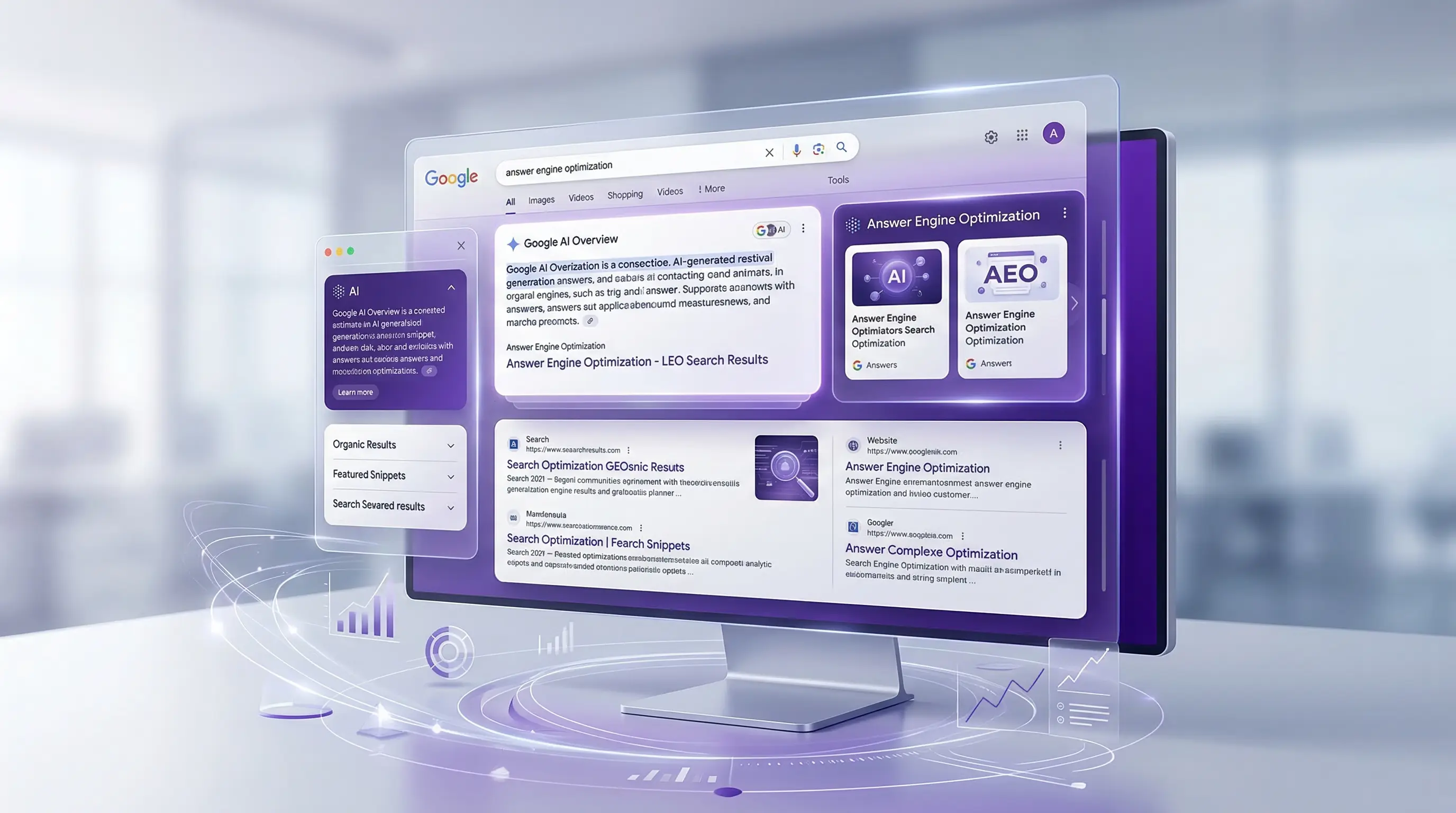
GEO and AEO for service businesses in 2026 require structured pages that answer high-intent questions directly, support claims with clear details, and expose machine-readable context through schema. The objective is not only ranking in traditional search; the objective is being cited in AI-generated responses. This shift from “ranking links” to “being the answer” represents the most significant change in search behavior since mobile-first indexing.
Service brands that win citations usually combine three elements: answer-first page structure, consistent entity signals (organization, service, location), and trustworthy proof (case snapshots, reviews, and visible update dates). According to recent studies, AI-powered search features now appear in over 40% of search results, and businesses optimized for answer engines see 2-3x higher click-through rates from featured citations compared to traditional organic listings.
What exactly are GEO and AEO, and why do they matter now?
GEO (Generative Engine Optimization) focuses on optimizing content to be cited in AI-generated responses from tools like ChatGPT, Claude, Perplexity, and Google’s AI Overviews. AEO (Answer Engine Optimization) is the broader discipline of structuring content so it can be directly extracted and presented as answers, whether through voice assistants, featured snippets, or generative AI outputs.
The distinction matters because traditional SEO optimized for clicks and rankings, while GEO and AEO optimize for citations and direct answers. In Pakistan’s competitive service market, where businesses compete for visibility across healthcare, education, financial services, and technology consulting, this shift creates new opportunities for brands that adapt early.
Research from late 2025 shows that 65% of informational searches now trigger some form of AI-generated answer, and users are increasingly bypassing traditional result pages entirely. For service businesses, this means potential customers may learn about your offerings, compare your services to competitors, and form purchasing opinions without ever visiting your website unless you are cited as the authoritative source.
What should be on every high-value service page?
Every high-value service page should include a direct answer paragraph in the opening section, question-style H2 headings with immediate answers, service scope and implementation process, proof signals and concrete outcomes, FAQ section and valid JSON-LD schema. This structure helps both human buyers and retrieval systems understand page intent quickly and extract accurate information.
The opening paragraph should directly answer the primary question a visitor has. For example, if you offer accounting services in Lahore, your first paragraph should state exactly what services you provide, who you serve, and what outcomes clients can expect. This answer-first approach mirrors how AI systems retrieve and present information.
Question-style H2 headings serve dual purposes: they match how users phrase voice searches and they provide clear semantic markers for content extraction. Instead of “Our Process,” use “How does our service delivery process work?” This framing signals to both readers and AI systems that a direct answer follows.
Service scope should be explicit and specific. Vague descriptions like “comprehensive solutions” fail in answer engine optimization because they cannot be extracted as definitive facts. Instead, list exact deliverables, timelines, and methodologies. For Pakistani service businesses, this specificity includes mentioning cities served, languages supported (Urdu, English), and regulatory compliance (SECP, FBR, PSEB certifications where applicable).
How does llms.txt fit into the strategy?
Book a free strategy call - we'll audit your current setup and identify the highest-impact fixes.
llms.txt helps by offering a concise, crawler-friendly summary of your brand, services, and key pages. It should match your on-site facts exactly and be updated when offerings or positioning change. This emerging standard provides AI systems with a standardized entry point for understanding your business without parsing complex HTML.
The llms.txt file should live at your root domain (yoursite.com/llms.txt) and follow a simple markdown-like structure. Include your brand name, primary services, key differentiators, main locations, and links to your most important pages. For Pakistani businesses, this file should reference local credentials, regional expertise, and language capabilities.
Consistency between llms.txt and your on-site content is critical. AI systems cross-reference multiple sources, and discrepancies can reduce citation confidence. If your website claims “15 years of experience” but llms.txt says “founded in 2015,” this inconsistency may prevent your content from being cited as authoritative.
Which schema types matter most for service businesses?
At minimum, use Organization, WebPage, Service (or ItemList of services), FAQPage, and BreadcrumbList where applicable. For editorial pages, use Article or BlogPosting with publication and modification dates. These schema types provide structured data that AI systems can parse with high confidence.
The Organization schema should include your official business name, logo URL, contact information, founding date, and relevant certifications. For Pakistani businesses, include your NTN (National Tax Number), SECP registration if applicable, and any industry-specific credentials like PSEB registration for IT companies.
Service schema enables you to define specific offerings with clear attributes: service type, area served, provider, and offers (pricing where appropriate). This granularity allows AI systems to match user queries like “find accounting services in Karachi” with precise service definitions.
FAQPage schema is particularly valuable because it creates explicit question-answer pairs that AI systems can extract directly. Each FAQ should address a specific, commonly-searched question with a concise, factual answer. For service businesses, FAQs should cover pricing ranges, service areas, timelines, and qualification questions.
Why do entity consistency and proof signals matter for citations?
AI systems prioritize sources that demonstrate consistency across the web and provide verifiable proof of claims. Entity consistency means your business name, address, phone number, and key facts match across your website, Google Business Profile, social media, directory listings, and third-party mentions.
Proof signals include client testimonials with verifiable details, case studies with measurable outcomes, professional certifications, industry awards, media mentions, and visible update dates showing content freshness. These signals build the “confidence score” that determines whether AI systems cite your content.
For Pakistani service businesses, proof signals should include local context: Karachi Chamber of Commerce membership, Lahore-based client testimonials, Pakistan-specific case studies, and references to local regulatory compliance. Generic global credentials have less citation value than locally-relevant proof.
How should service businesses structure content for voice and AI queries?
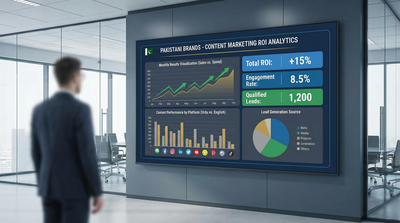
How we helped a Pakistani business achieve measurable results.
Voice and AI queries tend to be conversational and question-based, often starting with who, what, where, when, why, or how. Content should mirror this structure by leading with direct answers, using natural language, and avoiding jargon that AI systems might misinterpret.
Each section of your service pages should answer a specific question completely within 2-3 sentences for simple answers or 150-300 words for complex topics. This length matches the typical snippet size that AI systems extract and present to users.
Use plain language that matches how your customers actually speak. Instead of “leveraging synergistic paradigms,” say “combining methods that work together.” AI systems trained on diverse web content prefer clear, accessible language over marketing speak.
For Pakistani businesses, consider bilingual content strategy. Many users search in Roman Urdu or mix Urdu and English. Including commonly-used local terms and phrases can improve relevance for regional AI queries, though primary content should remain in your target business language.
What is the recommended implementation process for GEO/AEO optimization?
Phase one involves auditing existing content for answer-readiness. Review your top 10 service pages and identify whether each page directly answers the primary question a searcher would have. Grade each page on clarity, specificity, and proof signals.
Phase two focuses on restructuring priority pages. Rewrite opening paragraphs to be answer-first, convert generic headings to question format, add FAQ sections with 5-10 relevant questions, and implement schema markup. Test schema validity using Google’s Rich Results Test and other schema validators.
Phase three adds the llms.txt file and ensures entity consistency across the web. Claim and verify your Google Business Profile, update directory listings, and align social media profiles with your website facts.
Phase four establishes monitoring and iteration. Track AI referral traffic using analytics, monitor brand mentions in AI-generated responses, and collect feedback on which content drives citations. Refresh content quarterly or when market conditions change significantly.
How often should GEO/AEO pages be refreshed?
Refresh priority pages quarterly or when market conditions change. Update dates, statistics, examples, and FAQs so engines and users see clear freshness signals. AI systems often weight recent content more heavily, especially for time-sensitive queries about pricing, availability, or current offerings.
For Pakistani service businesses, refresh timing should align with local market cycles: fiscal year updates (July in Pakistan), budget announcements, regulatory changes, and seasonal demand patterns. A tax consultancy should update content before and after tax filing deadlines; an educational service should refresh around admission seasons.
Minor updates (statistics, dates, new FAQs) can be done monthly. Major content restructures should happen quarterly at minimum. Always update the last_updated date in your page metadata and schema to signal freshness.
Which metrics indicate GEO/AEO success?
Traditional SEO metrics like rankings and organic traffic remain relevant but should be supplemented with AI-specific metrics. Track referral traffic from AI platforms using UTM parameters and analytics segmentation. Monitor brand mentions in AI-generated responses through manual testing and emerging AI monitoring tools.
Citation share measures how often your business is mentioned when users ask relevant questions. Test this by querying various AI systems with questions like “What are the best accounting firms in Lahore?” or “How do I choose a web development company in Pakistan?” and noting whether your brand appears.
Answer accuracy ensures AI systems cite your content correctly. Incorrect citations (wrong pricing, outdated services) can damage reputation even when they drive traffic. Regular testing helps identify and correct misinformation before it spreads.
For service businesses, the ultimate metric is lead generation. Track whether AI referrals convert to inquiries, consultations, or sales. High citation rates with low conversion may indicate targeting the wrong queries or attracting users outside your service area.
What common mistakes should service businesses avoid?
Over-optimization for AI at the expense of human readability is the most common mistake. Content that reads like database entries rather than helpful guidance may get extracted but will not convert visitors into customers. Balance structure with engaging, valuable content.
Inconsistent information across platforms undermines citation confidence. If your website says you serve “all of Pakistan” but your Google Business Profile lists only Lahore, AI systems may not cite either claim with confidence. Audit and align all public information regularly.
Neglecting local context is particularly problematic for Pakistani businesses. Generic global SEO advice often ignores the importance of local credentials, regional search patterns, and Pakistan-specific platforms. Adapt international best practices to local market realities.
Ignoring mobile and voice users limits reach. Many AI searches occur on mobile devices or through voice assistants. Ensure content loads quickly on mobile, uses responsive design, and answers are concise enough for voice playback.
GEO/AEO Action Checklist
Content Structure
- Opening paragraph directly answers primary question
- H2 headings phrased as questions
- Each section contains complete, extractable answers
- Service scope and process clearly defined
- FAQ section with 5-10 relevant questions
Technical Implementation
- Organization schema with complete business details
- Service schema for each offering
- FAQPage schema validated and error-free
- BreadcrumbList schema on all pages
- llms.txt file published and accurate
Proof Signals
- Client testimonials with verifiable details
- Case studies with measurable outcomes
- Professional certifications displayed
- Last updated dates visible and current
- Local credentials and memberships listed
Monitoring and Maintenance
- Monthly AI referral traffic tracking
- Quarterly citation testing across AI platforms
- Content refresh schedule established
- Entity consistency audit completed
- Conversion tracking for AI-sourced leads
Frequently Asked Questions
What is the difference between GEO and traditional SEO?
Traditional SEO optimizes for ranking positions in search result pages, focusing on keywords, backlinks, and technical performance. GEO optimizes for being cited as the authoritative source in AI-generated responses, focusing on answer clarity, entity consistency, and structured data. While related, they require different content strategies and success metrics.
How long does it take to see GEO results?
Unlike traditional SEO which can take 3-6 months to show ranking improvements, GEO results can appear within weeks if your content is structured correctly. However, building citation authority and consistent AI mentions typically takes 2-4 months of sustained optimization and content freshness maintenance.
Do I need separate content for AI optimization?
No, well-structured content serves both human visitors and AI systems. The key is organizing information so it can be easily extracted: direct answers, clear headings, and structured data. Content that helps AI systems also improves user experience by being more scannable and informative.
How do I know if AI systems are citing my content?
Direct testing is currently the most reliable method. Query AI systems with relevant questions about your services and industry. Emerging tools also monitor AI-generated content for brand mentions. Track referral traffic from AI platforms using analytics to identify citation-driven visits.
Is GEO relevant for local Pakistani service businesses?
Absolutely. Local queries like “best dentist in Islamabad” or “accounting services in Faisalabad” increasingly trigger AI-generated answers. Businesses optimized for these queries can capture local market share before competitors adapt. Pakistan’s growing digital adoption makes early GEO investment particularly valuable.
Should I hire a specialist for GEO implementation?
Basic GEO implementation (content restructuring, schema markup, llms.txt) can be done in-house with proper guidance. Advanced strategies involving multi-platform optimization, ongoing monitoring, and competitive analysis may benefit from specialist expertise. For Pakistani businesses, prioritize consultants who understand local market context.
Service businesses that publish clearer answers with stronger structure tend to earn more inclusion in AI-generated results. The shift from ranking to being cited represents a fundamental change in how customers discover and evaluate services. Businesses that adapt now will build citation authority that compounds over time, while those that delay may find themselves invisible in the AI-powered search landscape.