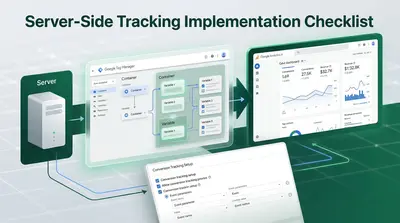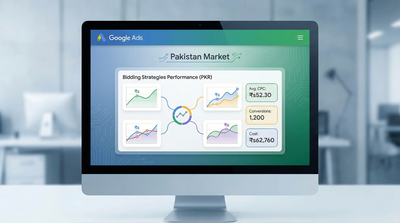

67% of Google Ads accounts carry conversion tracking errors that waste an average 34% of ad spend, according to Ryze AI’s 2026 audit analysis. For Pakistani ecommerce businesses — where Cash on Delivery rejection and cross-domain payment flows create additional misattribution — that percentage likely understates the problem. This teardown examines the default GA4 configuration most Pakistani businesses deploy and diagnoses exactly where it silently bleeds budget.
The pattern repeats across Lahore fashion stores, Karachi electronics retailers, and Islamabad SaaS companies. A developer installs the GA4 tag through a WordPress plugin or Google Tag Manager. Enhanced Measurement stays on in its default state. A few events get marked as conversions — typically “purchase” and maybe “lead.” Google Ads gets linked. The team calls the setup done and starts spending. Most businesses driving Pakistan’s growing digital commerce revenue operate this exact configuration today.
For a business running PKR 300,000 monthly on Google Ads, 34% waste translates to PKR 102,000 burning every month into phantom optimization.
No one investigates. The dashboards look healthy.
What this gets right
The default GA4 setup delivers a functional baseline. Events fire. Page views register. Sessions track across devices. Enhanced Measurement captures scrolls, outbound clicks, and site searches automatically — behavioral signals that Universal Analytics required manual configuration to collect. For a Pakistani business graduating from no analytics at all, this baseline represents measurable progress.
Google’s auto-linking between GA4 and Google Ads feeds conversion data into bidding algorithms within 24 hours. A Karachi-based store that previously relied entirely on Meta Ads Manager for performance data gains a second measurement lens overnight. The platform also provides predefined reports for ecommerce, engagement, and acquisition that populate with zero configuration.
The event model itself outperforms its predecessor. GA4’s flexible event structure supports custom parameters that capture Pakistan-specific signals — payment method, delivery city, currency — without schema modifications. When configured correctly, this data model supports analysis that Universal Analytics could never deliver. The cost of entry is zero. GA4 is free. The default setup requires no developer time beyond pasting the tracking tag. For Pakistani SMEs with limited budgets, this accessibility matters. A store owner can install GA4 via Google Tag Manager in under an hour and begin collecting data the same day.
Where this breaks
Duplicate tracking inflates every metric it touches. When a business installs GA4 through both a WordPress plugin and Google Tag Manager, or when Enhanced Measurement runs alongside manually configured page_view events, the same action fires twice. Page views, scrolls, and purchases register at 200% of actual volume. ITU Online’s technical analysis found that duplicate tracking inflates reported metrics by 40-100%. Smart Bidding sees inflated conversion volume and bids aggressively on traffic that generates phantom events rather than real revenue. No one questions the numbers because high numbers feel like good numbers.
Conversion events target the wrong actions. ATNRCO’s review of Pakistani ecommerce tracking setups identified a recurring pattern: businesses mark page views as conversions. A “thank you” page view becomes a “purchase” event. This works cleanly when the page loads only after a completed transaction. But for stores offering Cash on Delivery — the dominant payment method for Pakistani ecommerce — the thank you page fires at order placement, not at delivery confirmation. With COD rejection rates reaching 30-40% in certain categories, the conversion data overstates actual revenue by a corresponding margin. Google Ads then optimizes toward these phantom conversions, driving traffic that places orders but never completes payment.
Cross-domain tracking breaks without warning. Pakistani stores commonly route payments through JazzCash, Easypaisa, or bank redirect pages on separate domains. Without cross-domain linker configuration, GA4 treats each domain transition as a new session. A customer who clicks an ad, browses products on the main site, and completes payment on a JazzCash redirect appears as two unrelated users. Trendfingers’ GA4 audit data shows that 38% of accounts lack proper cross-domain tracking, losing 30-60% of attribution when users convert across domains.
Last-click attribution masks the real performance picture. GA4 defaults to last-click attribution. But 73% of conversions involve multiple touchpoints, according to multiple audit analyses. A Lahore customer who discovers a brand through a Display ad, researches on the website over two days, and converts through branded search gets credited entirely to that final branded click. Display receives zero credit. The operator reduces display spend based on the dashboard. Volume drops. The operator never connects the decision to the attribution blind spot.
Mobile tracking gaps hit Pakistani stores disproportionately. Pakistani mobile traffic exceeds 70% of total website visits for most ecommerce stores. Safari’s Intelligent Tracking Prevention blocks client-side tracking cookies on iOS devices by default. Firefox’s Enhanced Tracking Prevention does the same on Android. Together, these browser restrictions cause 25-45% mobile conversion data loss for accounts relying solely on client-side tracking, according to ITU Online’s troubleshooting analysis. The default GA4 setup has no mechanism to compensate for this gap. A Karachi fashion store that sees 80% of traffic from mobile devices operates with nearly half its mobile conversion data invisible to optimization algorithms.
The Meta Pixel duplication problem compounds everything. Pakistani businesses running both Google Ads and Meta Ads face an additional layer of duplication. When Meta Pixel and Conversions API both fire for the same purchase without deduplication, Meta over-reports conversions. GA4 counts the same purchase independently. Two platforms, each overstating their contribution, competing for credit on identical revenue. Budget allocation between Google and Meta becomes guesswork dressed up as data-driven decision-making.
The corrections are not complex. Deduplication logic, accurate conversion mapping, cross-domain linker setup, and a switch to data-driven attribution resolve most of these issues within one to two weeks. Ryze AI reports that businesses implementing these fixes recover 20-25% of wasted spend within the first month. For a Pakistani business spending PKR 300,000 monthly, that is PKR 60,000 to PKR 75,000 recovered — exceeding the typical audit cost.
Most teams miss this because the dashboards never look broken.
But a dashboard reporting 100 conversions when 65 actually occurred is not a reporting error. It is a budget allocation error that compounds daily.
Frequently Asked Questions
Book a free strategy call - we'll audit your current setup and identify the highest-impact fixes.
How can a Pakistani business check if its GA4 setup has duplicate tracking?
Open GA4 DebugView in real time and complete a test purchase or form submission. If two identical events appear for a single action, duplicate tracking is active. Check Google Tag Manager for overlapping tags — a CMS plugin GA4 tag firing alongside a GTM-configured tag is the most common cause. Disable one instance. Also verify that Enhanced Measurement is not duplicating manually configured page_view events.
What does a GA4 tracking fix cost for a Pakistani SME?
A tracking audit and correction typically costs between PKR 80,000 and PKR 200,000 depending on conversion event complexity and platform integrations. Compare this against the monthly waste. A business spending PKR 300,000 monthly with 34% waste bleeds PKR 102,000 every month — the fix pays for itself within the first billing cycle through recovered ad spend alone.
Why does Cash on Delivery create GA4 tracking problems for Pakistani stores?
COD creates a gap between order placement and confirmed revenue. Standard GA4 purchase events fire at checkout completion, but 30-40% of COD orders in certain Pakistani categories get returned or rejected at delivery. Tracking checkout as “purchase” overstates conversions by this margin. The fix requires delayed conversion tracking that fires only after delivery confirmation, typically connected through the order management system or CRM backend.
Should Pakistani businesses switch to data-driven attribution in GA4?
Yes, but only after verifying conversion tracking accuracy. Data-driven attribution distributes credit across touchpoints and improves bidding signals for upper-funnel campaigns. The model amplifies whatever data quality exists — accurate data produces better optimization, but duplicated or misattributed data produces worse optimization. Fix tracking first, then switch. Most businesses see measurable ROAS improvement within 30 to 45 days of the combined correction.