
Clarity
Cleaner reporting and faster decisions
100+ reviews - 24/7 support - 30-day money-back guarantee
+92 300 0133399Services
Design loyalty and referral systems that grow repeat purchases and customer advocacy.
Main Service
Sub Service
Loyalty and Referral Programme Setup
Overview
Design loyalty and referral systems that grow repeat purchases and customer advocacy. We handle implementation, QA, and continuous optimization.
Common Gaps
Scope
Design loyalty and referral systems that grow repeat purchases and customer advocacy. The scope is built for practical execution and compounding performance gains.
Execution Flow
Discovery and baseline audit
Implementation plan and sprint breakdown
Deployment, validation, and QA
Optimization cycles with reporting insights
Continuous improvement roadmap
Impact Focus
Cleaner reporting and faster decisions
Lower waste and smoother execution workflows
Higher conversion and stronger revenue contribution
Engagement Models
Related Planning
Next Step
Request a practical scope with timelines, deliverables, and next-step priorities.
Questions
Yes. We deliver this service for businesses in Pakistan with execution support across strategy, setup, and optimization.
We commonly support Lahore, Karachi, Islamabad, and remote teams across Pakistan.
Most projects start with a 2-4 week setup phase followed by continuous optimization cycles.
Yes. We can work as an embedded partner and coordinate with your internal marketing, sales, and leadership workflows.
Our lead nurture sequence actually works now. Prospects receive relevant information at the right time automatically.
Let's discuss how Lifecycle and Retention Marketing can help you achieve your goals. No obligation, just honest advice.
Free consultation · No commitment · Response within 24 hours
Loyalty and referral programme setup is the strategic design and technical implementation of systems that reward repeat purchases and incentivize customers to recommend your business to others. A well-designed loyalty programme increases customer lifetime value by 5-25% while referral programmes typically acquire new customers at 25% of the cost of traditional marketing channels. For Pakistani businesses facing rising customer acquisition costs and intense competition, loyalty and referral programmes transform satisfied customers into repeat buyers and active advocates, creating sustainable growth through existing customer relationships rather than expensive acquisition efforts.
For businesses in Lahore, Karachi, Islamabad, and across Pakistan, loyalty and referral programmes address two critical business challenges simultaneously. First, they increase retention and purchase frequency by giving customers concrete reasons to choose your business over competitors. Second, they leverage existing customer satisfaction to drive new customer acquisition through trusted personal recommendations. In a market where word-of-mouth remains highly influential, referral programmes formalize and amplify the advocacy that would otherwise happen organically. This service provides complete implementation from strategy design and economics modeling to technical setup, launch, and continuous optimization.
Loyalty programmes are structured marketing systems that reward customers for repeat purchases and continued engagement with your brand. Rewards typically include points earned per purchase, tier-based benefits for high-value customers, exclusive access to products or services, or cashback on purchases. The fundamental principle is that customers who receive tangible benefits for their loyalty have strong incentives to concentrate their purchases with your business rather than competitors.
Referral programmes are systems that incentivize existing customers to recommend your business to friends, family, and colleagues. Successful referrals typically reward both the referrer and the new customer, creating mutual benefit that encourages participation. Referral programmes formalize the word-of-mouth recommendations that drive many purchase decisions, making advocacy trackable and scalable.
These programmes matter because they directly address the economics of customer retention and acquisition. Research consistently shows that increasing customer retention by just 5% can increase profits by 25-95%, as retained customers buy more over time, cost less to serve, and refer others. Meanwhile, referred customers have 16% higher lifetime value than non-referred customers and 18% lower churn rates, making referral acquisition among the most valuable customer acquisition channels.
Book a free strategy call - we'll audit your current setup and identify the highest-impact fixes.
Loyalty programmes work by creating a value exchange where customers receive tangible benefits for continued patronage, and businesses receive increased purchase frequency, larger basket sizes, and stronger customer relationships.
Points-Based Systems: The most common loyalty structure where customers earn points based on purchase value, which can be redeemed for rewards. Points create a visible accumulation that customers want to maximize, and redemption moments reinforce the value of programme participation. Points-based systems are flexible and can be adjusted based on business economics.
Tier-Based Systems: Customers progress through levels (such as Silver, Gold, Platinum) based on cumulative spending or activity, with higher tiers providing better benefits. Tiers create aspiration and status competition that drives increased spending. Tier-based systems are particularly effective for businesses with significant high-value customer segments.
Cashback and Discount Structures: Simpler programmes that provide direct monetary benefits through percentage returns on purchases or exclusive discounts. These programmes are easier to understand but may feel less differentiated than points or tier systems.
Paid Membership Programmes: Customers pay a fee to access exclusive benefits, discounts, or experiences. Paid programmes create committed membership and guaranteed revenue, but require compelling value propositions to justify the cost.
Hybrid Approaches: Many successful programmes combine multiple elements, such as a free points-based tier with a premium paid membership option, or points earning with tier-based benefits.
The key to loyalty programme success is ensuring the rewards are valuable enough to influence behavior while remaining economically sustainable. Programme economics must account for reward costs, increased purchase frequency, and the value of customer data and engagement that programmes generate.
Referral programmes work by formalizing and incentivizing the word-of-mouth recommendations that naturally occur when customers have positive experiences. Effective referral programmes make sharing easy, reward both parties appropriately, and track attribution accurately.
Referral Link Systems: Each customer receives a unique referral link to share via email, social media, or messaging apps. When new customers use the link, the referral is tracked and rewards are triggered. This structure enables precise attribution and easy sharing across digital channels.
Referral Code Systems: Customers share unique codes that friends enter during signup or checkout. Codes are memorable and work well for word-of-mouth sharing in person or via messaging apps where link sharing may be awkward.
Invite-Only Programmes: Exclusive programmes where existing members invite select friends to join. The exclusivity increases perceived value and encourages quality referrals rather than mass sharing.
Tiered Referral Rewards: Programs that increase rewards based on referral quantity or quality. First referrals might earn a standard reward, while multiple successful referrals earn bonus rewards, encouraging sustained advocacy.
Social Sharing Integration: Programmes integrated with social media platforms make sharing seamless and enable tracking of social-driven referrals. Social integration also enables viral referral growth when offers resonate.
The key to referral programme success is ensuring the referral experience is natural and easy for customers, the rewards motivate sharing but remain economically sustainable, and the attribution accurately tracks referrals without being gamed.
The Pakistani market presents unique characteristics that influence optimal loyalty and referral programme design.
Cash-Value Rewards: Pakistani consumers tend to respond strongly to concrete monetary benefits. Points systems that clearly translate to cash-equivalent value, direct cashback programmes, and discount-based rewards often perform better than abstract point systems or status-based benefits alone.
Mobile-First Experience: With high smartphone penetration and mobile commerce growth, programmes must work seamlessly on mobile devices. WhatsApp integration for referral sharing, mobile app-based loyalty tracking, and SMS notifications are essential for Pakistani market success.
Family and Group Programmes: Pakistani consumers often make purchasing decisions at the household level. Programmes that allow family sharing of benefits, household point pooling, or group referral bonuses align with cultural purchasing patterns.
Tiered Recognition: While monetary rewards drive primary motivation, status and recognition matter for high-value customer segments. Exclusive access, priority service, and visible status indicators appeal to aspirational consumers.
Local Relevance: Programme rewards, communication style, and programme naming should reflect local culture and preferences. Generic global programme designs often underperform locally adapted versions.
Cash on Delivery Integration: Many Pakistani consumers prefer cash on delivery. Loyalty programmes should accommodate COD purchases, potentially requiring order confirmation before point crediting, while still creating seamless customer experiences.
How we helped a Pakistani business achieve measurable results.
Loyalty and referral programmes are particularly important for Pakistani business growth due to specific market dynamics that make retention and advocacy essential.
Rising Acquisition Costs: As digital marketing competition intensifies in Pakistan, customer acquisition costs continue rising across channels. Loyalty programmes reduce dependence on expensive acquisition by increasing value from existing customers. Referral programmes provide lower-cost acquisition through customer advocacy.
Competitive Differentiation: Pakistani markets are increasingly competitive with both local and international players. Loyalty programmes create switching costs that make customers less likely to defect to competitors. A customer with accumulated points or tier status has concrete reasons to continue purchasing from your business.
Word-of-Mouth Culture: Pakistani consumer culture places high value on personal recommendations. Friends’ and family members’ opinions significantly influence purchase decisions. Referral programmes formalize this cultural tendency, making advocacy trackable and scalable.
Customer Data and Insights: Loyalty programmes generate valuable customer data including purchase patterns, preferences, and engagement levels. This data enables better marketing, product development, and customer service decisions across the business.
Reduced Price Sensitivity: Customers participating in loyalty programmes often become less price-sensitive because they value accumulated points or tier benefits. This enables businesses to compete on value and relationship rather than solely on price.
The implementation process for loyalty and referral programmes follows a structured approach ensuring strategic alignment, economic sustainability, and technical execution.
Step 1: Business Analysis and Programme Strategy We begin by analyzing your customer base, purchase patterns, margins, and competitive landscape to determine optimal programme design. We define programme objectives, whether focused on retention, acquisition, basket size, or frequency, and design programme structure aligned with these objectives. We model programme economics including reward costs, expected behavior change, and projected ROI.
Step 2: Programme Design and Economics Finalization We design specific programme mechanics including point earning rates, redemption options, tier thresholds and benefits, or referral reward structures. We finalize programme economics with sensitivity analysis for various participation and redemption scenarios. We develop programme rules, terms, and communication frameworks.
Step 3: Technology Platform Selection and Configuration Based on programme requirements, we select appropriate technology platforms for loyalty and referral management. This may include standalone loyalty platforms, e-commerce platform extensions, or custom development. We configure the platform with programme rules, reward structures, and customer-facing interfaces.
Step 4: Integration with Existing Systems We integrate loyalty and referral platforms with your e-commerce store, point of sale systems, email marketing, and customer data infrastructure. Integration ensures seamless earning and redemption, accurate tracking, and coordinated communication across channels.
Step 5: Customer Experience Design and Content We design the customer-facing programme experience including enrollment flows, member dashboards, reward catalogs, and communication touchpoints. We create programme branding, naming, and marketing materials. We develop launch communication strategies for existing customers and new customer introduction flows.
Step 6: Testing and Quality Assurance Before launch, we conduct comprehensive testing including enrollment processes, earning and redemption workflows, referral tracking accuracy, tier progression, and customer communications. We verify programme economics are functioning as designed and customer experience is seamless.
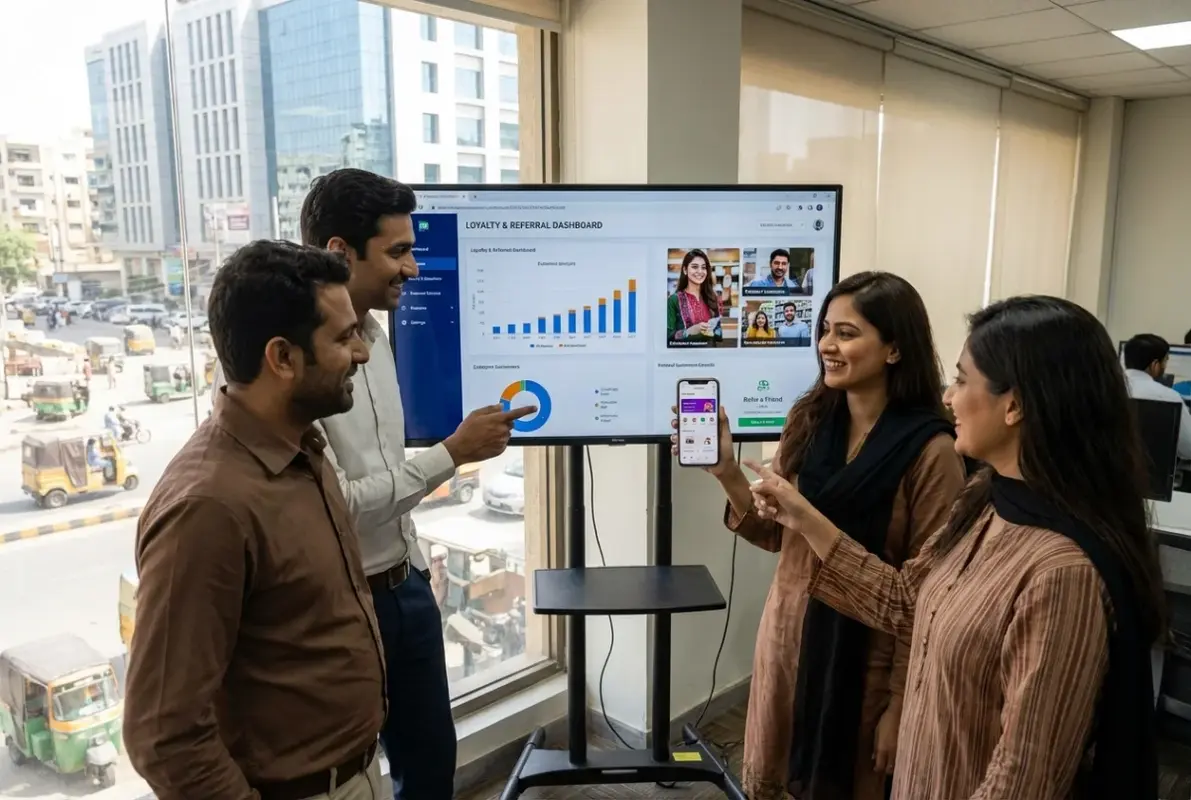
Step 7: Launch and Performance Monitoring We execute programme launch to existing customers and integrate programme promotion into ongoing marketing. We establish monitoring dashboards tracking key metrics including enrollment rate, participation rate, redemption rate, referral rate, and programme-attributable revenue. Early monitoring identifies issues requiring rapid adjustment.
Step 8: Continuous Optimization Loyalty and referral programmes require ongoing optimization based on performance data and member feedback. We analyze programme metrics to identify improvement opportunities, test programme variations, and continuously refine reward structures, communication, and customer experience. Regular reviews ensure programmes remain competitive and economically sustainable.
Effective loyalty and referral programmes require technology platforms that manage membership, track activity, process rewards, and integrate with existing business systems.
E-Commerce Platform Extensions: For businesses on platforms like Shopify, WooCommerce, or Magento, extensions like Smile.io, LoyaltyLion, and Yotpo provide integrated loyalty functionality with simpler implementation.
Standalone Loyalty Platforms: Purpose-built platforms like Antavo, Annex Cloud, and Comarch provide comprehensive loyalty programme capabilities for more complex requirements including multi-store programmes, complex earning rules, and sophisticated tier structures.
Referral-Specific Platforms: Tools like ReferralCandy, Mention Me, and GrowSurf focus specifically on referral programme management with specialized features for referral tracking and optimization.
Custom Development: For businesses with unique requirements or existing technical infrastructure, custom development provides maximum flexibility. This approach requires more investment but enables precisely tailored programmes.
Marketing Automation Integration: Platforms like Klaviyo and HubSpot integrate with loyalty platforms to enable coordinated lifecycle marketing that leverages loyalty status and activity data.
For Pakistani businesses, we evaluate platform options based on integration requirements, programme complexity, mobile experience, and local market considerations including WhatsApp and SMS capabilities.
Success measurement focuses on programme participation, behavior change, and business impact. Key metrics provide visibility into programme effectiveness and optimization opportunities.
Participation Metrics: Enrollment rate measures what percentage of customers join the programme. Active participation rate measures what percentage of members actively engage with programme features. Referral participation rate measures what percentage of customers make successful referrals.
Behavior Change Metrics: Purchase frequency lift compares purchase frequency of programme members versus non-members. Average order value lift compares basket sizes of members versus non-members. Retention rate improvement measures reduced churn among programme participants.
Referral Programme Metrics: Referral rate measures referrals per customer over time. Referral conversion rate measures what percentage of referred prospects become customers. Referred customer value compares lifetime value of referred versus non-referred customers.
Programme Economics: Reward cost as percentage of revenue ensures programme remains economically sustainable. Programme-attributable revenue estimates incremental revenue driven by programme participation. Programme ROI compares programme costs including rewards and operations against incremental revenue.
Customer Satisfaction: Net Promoter Score of programme members versus non-members. Programme satisfaction through surveys and feedback. Customer support inquiries related to programme indicate friction points.
For Pakistani businesses, we recommend tracking metrics from programme launch with clear baselines for comparison. Regular reporting should include trend analysis showing whether programme performance improves over time and whether programme delivers projected returns.
We deliver loyalty and referral programme setup services across Pakistan, with particular focus on major commercial centers including Lahore, Karachi, Islamabad, Rawalpindi, Faisalabad, Multan, and Peshawar. Our team provides both remote implementation support and on-site consultation for businesses requiring hands-on strategic guidance.
Service engagement models include one-time setup sprints for businesses establishing their first loyalty or referral programmes, monthly retainers for ongoing optimization and programme expansion, and hybrid models combining initial build phases with continuous improvement cycles. We coordinate with your existing marketing, operations, and finance teams to ensure loyalty and referral programmes integrate seamlessly with your broader customer engagement and business strategy.
Implementation typically begins with a 2-4 week strategy and design phase, followed by technical implementation and testing, with ongoing optimization cycles focused on improving participation rates, behavior change, and programme ROI.
Explore More
Digital marketing for accounting firms focused on client acquisition, trust-building content, and lead conversion systems. Built for businesses in Pakistan that need measurable growth.
Open page →Digital marketing for agricultural businesses focused on B2B lead generation, farmer outreach, and agricultural input and equipment marketing. Built for businesses in Pakistan that need measurable growth.
Open page →Digital marketing for architects focused on project inquiries, firm visibility, and client acquisition. Built for architecture practices in Pakistan that need measurable growth.
Open page →Explore More
Digital marketing agency support for businesses in Pakistan that need SEO, PPC, automation, attribution, and conversion systems tied to measurable growth.
Open page →PPC agency support in Karachi for lead-generation businesses and ecommerce brands that need accountable paid growth systems.
Open page →SEO agency support in Lahore for businesses that need stronger local and national rankings, technical SEO cleanup, and conversion-ready pages.
Open page →Start Here
Book a strategy call to discuss how WeProms Digital can help your business achieve better tracking, cleaner attribution, and more accountable growth.