
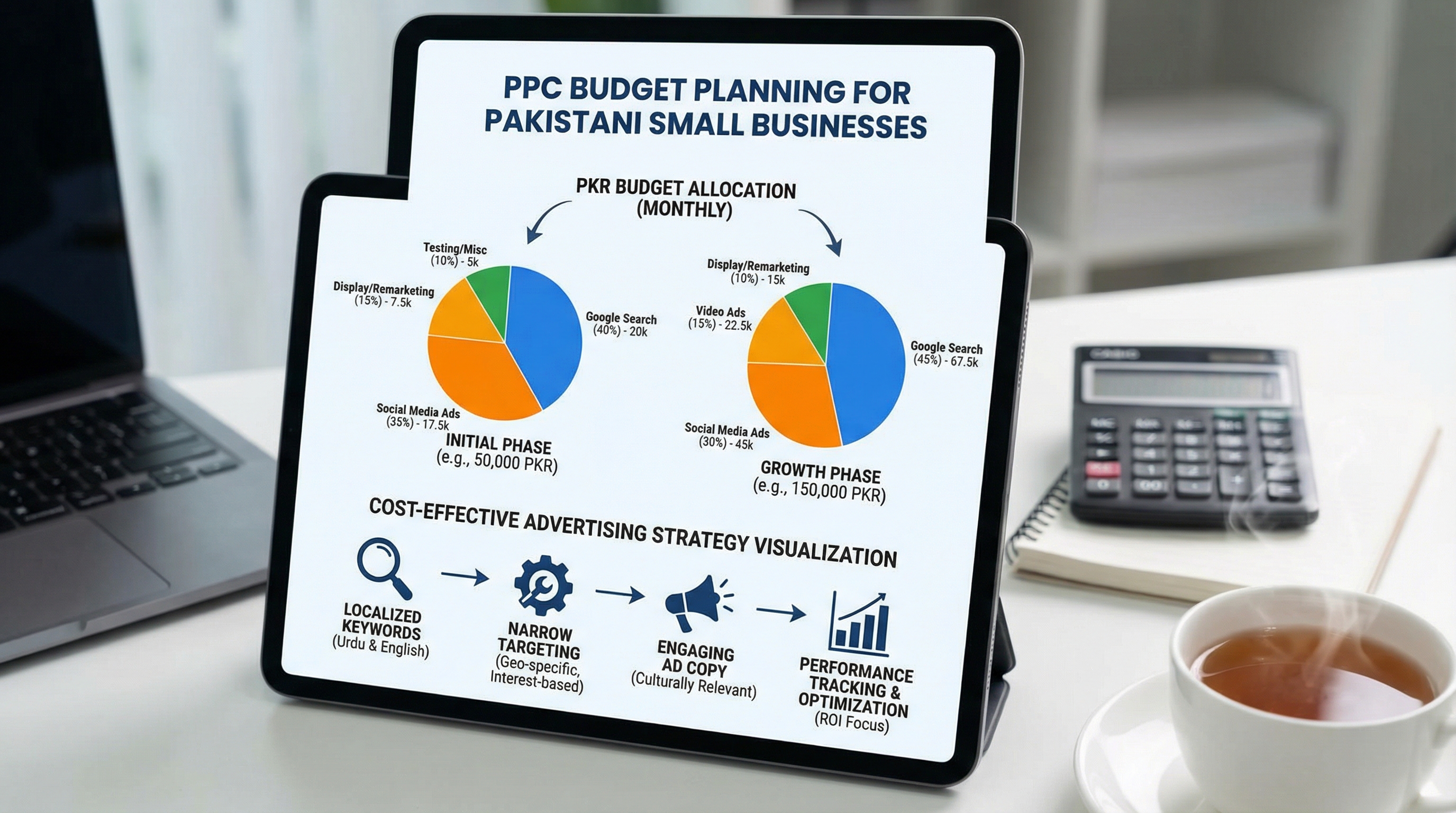
PPC budget planning for Pakistani SMBs often starts with uncertainty: How much should you spend? Where should you spend it? How do you know if it’s working? These questions prevent many businesses from starting paid advertising, while others waste money on poorly structured campaigns.
The reality is that effective PPC doesn’t require massive budgets—it requires strategic allocation. Pakistani businesses can achieve meaningful results with PKR 50,000-100,000 monthly when budgets are planned thoughtfully and optimized consistently. This guide covers how to plan, allocate, and scale PPC budgets for Pakistani small and medium businesses.
How much should Pakistani SMBs spend on PPC?
Budget sizing depends on your goals, industry, and current stage:
By business stage
Testing stage (new to PPC):
- Budget: PKR 30,000-75,000/month
- Focus: Learning what works, gathering data
- Expectation: Break-even or slight loss acceptable
- Duration: 2-3 months
Growth stage (proven concept):
- Budget: PKR 100,000-300,000/month
- Focus: Scaling winning campaigns, expanding reach
- Expectation: Positive ROI, clear attribution
- Duration: Ongoing with regular optimization
Scale stage (optimized, ready to grow):
- Budget: PKR 500,000+/month
- Focus: Market dominance, new channels, aggressive growth
- Expectation: Strong ROI, efficient CAC
- Duration: Ongoing with full-funnel approach
By industry
Different industries have different cost structures:
| Industry | Minimum Viable Budget | Competitive Budget | Average CPC |
|---|---|---|---|
| E-commerce Fashion | PKR 75,000/month | PKR 200,000+/month | PKR 15-40 |
| Education | PKR 50,000/month | PKR 150,000+/month | PKR 20-60 |
| Healthcare | PKR 50,000/month | PKR 100,000+/month | PKR 25-80 |
| Real Estate | PKR 100,000/month | PKR 300,000+/month | PKR 30-100 |
| Professional Services | PKR 40,000/month | PKR 100,000+/month | PKR 20-50 |
| Restaurant/Food | PKR 30,000/month | PKR 75,000+/month | PKR 10-30 |
Budget as percentage of revenue
A common benchmark: 5-10% of revenue for marketing, with 30-50% allocated to digital paid advertising:
- PKR 1 crore annual revenue: PKR 50-100 lakhs marketing, PKR 15-50 lakhs PPC
- PKR 5 crore annual revenue: PKR 25-50 lakhs marketing, PKR 7.5-25 lakhs PPC
Adjust based on growth goals (higher for aggressive growth) and margin structure (lower for low-margin businesses).
How should you allocate budget across channels?
Channel allocation depends on your business type and customer behavior:
By business model
E-commerce:
- Google Shopping: 40-50%
- Google Search: 20-30%
- Meta (Facebook/Instagram): 20-30%
- Retargeting: 10-15%
Lead generation (B2C):
- Google Search: 50-60%
- Meta (Facebook/Instagram): 30-40%
- Retargeting: 5-10%
Lead generation (B2B):
- Google Search: 60-70%
- LinkedIn: 20-30% (if budget allows)
- Meta: 10-20%
Local business:
- Google Search (with location targeting): 50-60%
- Meta: 30-40%
- Local directories: 10-20%
Channel-specific budget considerations
Google Ads:
- Higher intent, higher conversion rates
- Higher CPCs in competitive categories
- Better for capture than awareness
- Requires quality score optimization
Meta Ads (Facebook/Instagram):
- Lower CPCs, larger reach
- Better for awareness and consideration
- Strong retargeting capabilities
- Creative quality matters significantly
LinkedIn Ads:
- Highest B2B targeting precision
- Highest CPCs (3-5x Google)
- Best for senior decision-makers
- Smaller but higher-quality reach
How do you structure budgets within Google Ads?
Book a free strategy call - we'll audit your current setup and identify the highest-impact fixes.
Proper Google Ads budget structure improves optimization:
Campaign-level budgets
Allocate budgets at the campaign level based on objectives:
| Campaign Type | Budget Priority | Purpose |
|---|---|---|
| Brand Search | Medium | Protect brand, capture known demand |
| Non-Brand Search | High | Capture intent, new customer acquisition |
| Shopping | High (e-commerce) | Product discovery, purchase intent |
| Performance Max | Variable | Full-funnel automation |
| Display | Low-Medium | Awareness, retargeting |
Budget pacing strategies
Standard delivery: Spread budget evenly throughout the day. Best for most Pakistani SMBs.
Accelerated delivery: Spend budget as quickly as possible. Use only for time-sensitive campaigns.
Shared budgets: Combine budget across campaigns for flexibility. Good for related campaigns with similar performance.
Daily vs. monthly budget thinking
Google Ads uses daily budgets, but plan monthly:
- Daily budget = Monthly budget ÷ 30.4
- Account for monthly spend variance (up to 2x daily budget on high-traffic days)
- Monitor weekly to stay on track monthly
How do you scale PPC budgets effectively?
Budget scaling should follow performance, not precede it:
The 20-30% rule
When campaigns perform well, increase budgets gradually:
- Campaign meeting targets? Increase budget 20-30%
- Performance stable after 7-14 days? Increase another 20-30%
- Continue until performance degrades or budget ceiling reached
Avoid doubling budgets overnight—this disruptts algorithm learning and can tank performance.
Scaling triggers
Increase budget when:
- Consistent positive ROI for 2+ weeks
- Impression share below 50% on high-value keywords
- Lost budget due to daily caps
- Seasonal demand increases
Decrease budget when:
- ROI declining over 2+ weeks
- Cost per acquisition rising
- Click quality declining
- Seasonal demand decreases
New channel expansion
Add channels when:
- Existing channels optimized and scaled
- Clear understanding of target CPA
- Budget available for 3-month test
- Resources to manage additional complexity
How do you set PPC goals and KPIs?
Budget planning requires clear success metrics:
Primary KPIs by objective
Sales/Revenue:
- Return on Ad Spend (ROAS): Revenue ÷ Ad Spend
- Target: 3-5x for e-commerce, varies by margin
- Cost per Acquisition (CPA): Ad Spend ÷ Customers
Lead Generation:
- Cost per Lead (CPL): Ad Spend ÷ Leads
- Lead Quality: Lead-to-Customer conversion rate
- Cost per Qualified Lead: Ad Spend ÷ Qualified Leads
Brand Awareness:
- Cost per Thousand Impressions (CPM)
- Reach and frequency
- Video view rate (for video campaigns)
Setting realistic targets
Pakistani market benchmarks:
| Metric | Conservative | Good | Excellent |
|---|---|---|---|
| Search CTR | 2% | 4% | 6%+ |
| Conversion Rate | 2% | 4% | 6%+ |
| ROAS (e-commerce) | 2x | 4x | 6x+ |
| CPL (services) | PKR 2,000 | PKR 1,000 | PKR 500 |
What about seasonal budget planning?
How we helped a Pakistani business achieve measurable results.
Pakistani businesses face distinct seasonal patterns:
Major seasonal events
Ramadan and Eid:
- 2-3 months before Eid: Increase fashion, gifting budgets
- Ramadan: Adjust for changed consumer behavior
- Post-Eid: Reduced spending period
Wedding season:
- October-February peak
- Increase fashion, jewelry, venue budgets
- Higher CPCs during peak
Back to school:
- August-September
- Education, supplies, uniforms
End of year:
- November-December
- Clearance sales, holiday shopping
Budget planning calendar
| Month | Considerations |
|---|---|
| January | Wedding season peak, new year promotions |
| February | Wedding season continues, Valentine’s |
| March | Pre-Ramadan preparation |
| April | Ramadan (variable), adjusted consumer behavior |
| May | Eid preparations, increased shopping |
| June | Post-Eid slowdown, summer categories |
| July | Summer sales, travel |
| August | Back to school preparation |
| September | Education peak, Independence Day |
| October | Wedding season begins |
| November | Wedding peak, 11.11 sales |
| December | Wedding peak, year-end, holiday shopping |
Allocate 20-30% additional budget for peak months, reduce 10-20% for slow months.
How do you track and report PPC budget performance?
Regular reporting keeps budgets on track:
Weekly review
- Spend vs. budget pacing
- Campaign performance trends
- Keyword/ad performance changes
- Any alerts or issues
Monthly reporting
Executive summary:
- Total spend vs. budget
- Total conversions/revenue
- Overall ROI/ROAS
- Key wins and challenges
Channel breakdown:
- Spend and performance by platform
- Best and worst performing campaigns
- CPA/ROAS by channel
Optimization actions:
- Changes made during month
- Results of changes
- Planned changes for next month
Quarterly planning
- Budget review and adjustment
- Channel mix evaluation
- New channel testing plans
- Seasonal preparation
Common PPC budget mistakes for Pakistani SMBs
Underspending to start: Budget too low means insufficient data for optimization. Start with minimum viable budget for your industry.
Overspending before optimization: Pouring money into unoptimized campaigns wastes budget. Optimize first, then scale.
Ignoring mobile: 80%+ of Pakistani traffic is mobile. Ensure budgets account for mobile performance.
No conversion tracking: Without tracking, you’re guessing. Implement tracking before spending significantly.
Spreading too thin: Too many campaigns with small budgets perform poorly. Consolidate for impact.
Set and forget: PPC requires ongoing optimization. Budget for management time or agency fees.
Not testing creative: Creative refreshes prevent fatigue. Budget for regular creative development.
PPC budget planning template
Use this framework for your planning:
Monthly Budget Allocation:
| Category | Amount | % of Total |
|---|---|---|
| Google Search | PKR _____ | ___% |
| Google Shopping | PKR _____ | ___% |
| Meta (FB/IG) | PKR _____ | ___% |
| Retargeting | PKR _____ | ___% |
| Testing/New Channels | PKR _____ | ___% |
| Total | PKR _____ | 100% |
Target Metrics:
- Target CPA: PKR _____
- Target ROAS: _____x
- Monthly conversions: _____
- Monthly revenue from PPC: PKR _____
Quarterly Adjustments:
- Q1 Budget: PKR _____ (Reason: ___________)
- Q2 Budget: PKR _____ (Reason: ___________)
- Q3 Budget: PKR _____ (Reason: ___________)
- Q4 Budget: PKR _____ (Reason: ___________)
Getting started with PPC budgeting
For Pakistani SMBs new to paid advertising:
Week 1: Define goals, research industry benchmarks, set initial budget.
Week 2: Set up tracking, create campaigns, launch with conservative budgets.
Week 3-4: Monitor daily, optimize based on initial data, resist major changes.
Month 2: Evaluate performance, adjust budget allocation, scale winners.
Month 3+: Establish regular optimization rhythm, expand channels as performance justifies.
PPC success for Pakistani SMBs isn’t about big budgets—it’s about smart budget allocation, consistent optimization, and patient scaling based on data. Start with what you can afford to test, prove what works, and grow from there.