
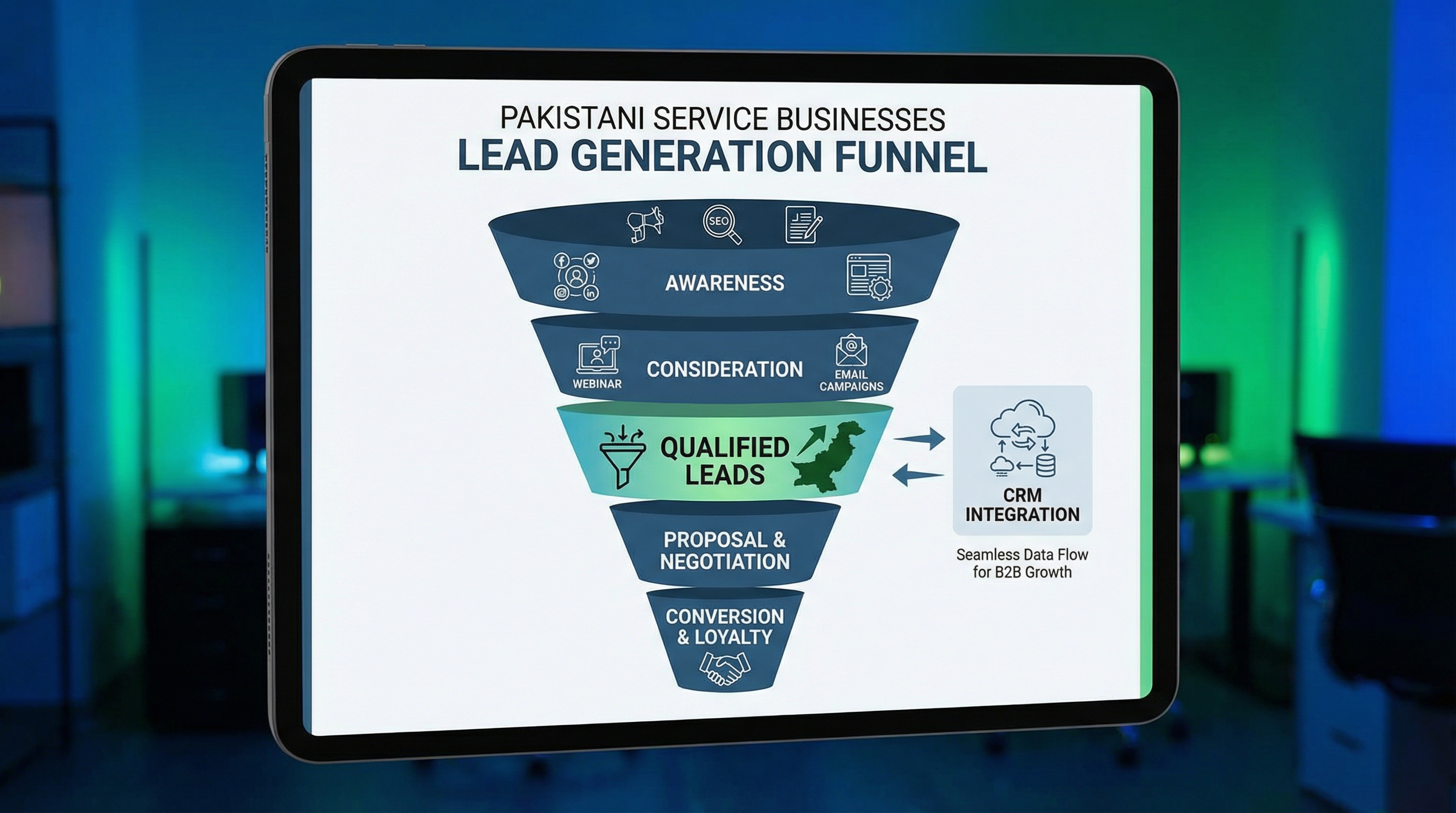
Lead generation for Pakistani service businesses requires a different approach than product-based e-commerce. Education providers, healthcare clinics, real estate agencies, legal firms, and professional service providers all share common challenges: longer sales cycles, higher trust requirements, and the need to demonstrate expertise before conversion.
What works in Pakistan often differs from Western markets. The preference for personal communication, importance of WhatsApp, and cultural factors around trust and relationships shape effective lead generation strategies. This guide covers proven tactics that actually work for Pakistani service businesses.
What makes service business lead generation different?
Service businesses face unique challenges that affect lead generation strategy:
Intangibility: Customers can’t see or touch what they’re buying. Trust and credibility become primary conversion factors.
Higher consideration: Most services require significant thought before purchase. Customers research, compare, and often consult others before deciding.
Relationship importance: Many services involve ongoing relationships. The initial lead generation sets expectations for the entire customer relationship.
Variable pricing: Service costs often depend on scope, making transparent pricing difficult. This affects how you can market and what information to provide.
Local focus: Most service businesses serve geographic areas. Lead generation must target the right locations.
Trust barriers: Pakistani consumers are increasingly skeptical of marketing claims. Proving credibility is essential.
What lead sources work best for Pakistani services?
Different sources serve different stages of the customer journey:
High-intent sources (ready to buy)
Google Search Ads: People searching “MBA admission Lahore” or “cardiologist in Karachi” have immediate intent. These leads convert at 5-15% rates.
- Best for: Services with clear search demand
- Typical CPL: PKR 500-3,000 depending on competition
- Key success factor: Landing page relevance and trust signals
Google Business Profile: Local searches (130K+ monthly in Pakistan for “near me” queries) produce high-intent leads.
- Best for: Location-based services with physical presence
- Typical cost: Free (investment is optimization effort)
- Key success factor: Reviews and complete profile
Directory listings: Industry-specific directories (WhatClinic for healthcare, Zameen for real estate) attract comparison shoppers.
- Best for: Healthcare, real estate, education
- Typical cost: PKR 10,000-50,000/year subscription
- Key success factor: Complete listings, response speed
Consideration sources (researching options)
Facebook and Instagram Ads: Social ads reach people earlier in their journey. Lower intent but larger audience.
- Best for: Services requiring education, brand building
- Typical CPL: PKR 300-1,500
- Key success factor: Targeting and creative quality
Content marketing: Blog posts, guides, and videos attract researchers and build credibility over time.
- Best for: Complex services, expertise demonstration
- Typical cost: PKR 15,000-35,000 per piece
- Key success factor: Quality and consistency
YouTube: Video content explaining services builds trust and reaches people in research mode.
- Best for: Visual services, demonstrations, testimonials
- Typical cost: PKR 50,000-150,000 per video
- Key success factor: Production quality and authenticity
Nurture sources (building awareness)
Email marketing: Nurtures leads not ready to buy immediately. Highest ROI for long-term relationship building.
- Best for: Services with 3-12 month sales cycles
- Typical cost: PKR 5,000-15,000/month (platform)
- Key success factor: Valuable content, consistent sending
WhatsApp broadcasts: Maintains top-of-mind awareness with leads who’ve engaged before.
- Best for: Services with repeat purchase potential
- Typical cost: PKR 1-5 per message
- Key success factor: Frequency and value balance
How do you optimize landing pages for Pakistani leads?
Book a free strategy call - we'll audit your current setup and identify the highest-impact fixes.
Landing pages for service businesses require specific elements:
Above the fold:
- Clear headline stating the benefit/outcome
- Subheadline addressing who you serve
- Hero image showing service context or team
- Primary call-to-action (form, call, WhatsApp)
Trust elements:
- Client logos or testimonials
- Certifications and credentials
- Years in business / projects completed
- Reviews and ratings
- Guarantees or risk reversals
Service explanation:
- What you do in customer terms
- Who it’s for (ideal customer profile)
- Process or methodology overview
- What makes you different
Lead capture:
- Simple form (3-5 fields maximum)
- Multiple contact options (form, phone, WhatsApp)
- Clear next steps explanation
- Privacy assurance
Mobile optimization:
- 80%+ of traffic is mobile
- Fast loading (under 3 seconds)
- Easy-to-tap buttons
- Click-to-call functionality
- WhatsApp integration
Pakistani-specific elements:
- Local phone numbers displayed
- Pakistani testimonials and case studies
- Local business address
- Reference to Pakistani context
- Urdu elements where appropriate
What lead magnets work for Pakistani services?
Lead magnets exchange value for contact information:
By industry:
| Industry | Effective Lead Magnets |
|---|---|
| Education | Course guides, career path documents, entrance exam tips, scholarship information |
| Healthcare | Symptom checkers, health guides, second opinion offers |
| Real Estate | Property valuation, area guides, investment calculators |
| Legal | Legal checklists, rights guides, consultation offers |
| Financial | Financial planning templates, tax guides, comparison tools |
| Professional Services | Industry reports, templates, audits |
Format preferences in Pakistan:
- PDF guides (most accepted)
- Video content (higher perceived value)
- Webinars (for B2B services)
- Free consultations (for high-value services)
- Quizzes/assessments (engagement focused)
Lead magnet best practices:
- Solve a real problem quickly
- Provide immediate value
- Lead naturally to your service
- Require minimal effort to consume
- Include next steps toward your service
How do you handle lead qualification?
Not all leads deserve equal attention. Qualification improves sales efficiency:
BANT framework adapted for Pakistan:
- Budget: Can they afford your services? (Direct asking is acceptable in Pakistani business culture)
- Authority: Are they the decision-maker? (Family involvement common in Pakistan)
- Need: Do they have a genuine need you can address?
- Timeline: When are they looking to proceed?
Lead scoring criteria:
| Factor | Points |
|---|---|
| Completed contact form | +10 |
| Requested callback | +15 |
| Phone number provided | +10 |
| WhatsApp message sent | +15 |
| Matched ideal customer profile | +20 |
| Timeline under 30 days | +15 |
| Budget confirmed | +20 |
Score 50+ = Hot lead (immediate follow-up) Score 25-49 = Warm lead (same-day follow-up) Score under 25 = Cold lead (nurture sequence)
What follow-up process works best?
How we helped a Pakistani business achieve measurable results.
Lead response time significantly impacts conversion:
Speed benchmarks:
- Under 5 minutes: 4x more likely to convert
- Under 1 hour: 2x more likely to convert
- Over 24 hours: Conversion rate drops 80%
Follow-up sequence for Pakistani leads:
Immediate (automated):
- SMS/WhatsApp confirmation of inquiry
- Brief “we received your message” response
Within 1 hour:
- Personal phone call
- WhatsApp message if call unanswered
- Gather additional information
- Schedule next steps
Day 1-2:
- Send relevant information promised
- Share testimonials or case studies
- Address questions raised
Day 3-5:
- Follow-up call or WhatsApp
- Offer consultation or meeting
- Provide additional value
Week 2+:
- Weekly nurture touchpoints
- Vary channels (call, WhatsApp, email)
- Continue until disqualification or conversion
WhatsApp integration: For Pakistani leads, WhatsApp is essential:
- Most leads prefer WhatsApp communication
- Voice messages allow efficient communication
- Document sharing is easy
- Response rates are highest
How do you measure lead generation success?
Key metrics for service business lead generation:
Volume metrics:
- Total leads generated
- Leads by source
- Leads by campaign
Quality metrics:
- Lead-to-opportunity rate
- Opportunity-to-customer rate
- Lead score distribution
Cost metrics:
- Cost per lead (CPL)
- Cost per qualified lead (CPQL)
- Cost per customer (CAC)
Revenue metrics:
- Pipeline value generated
- Revenue from leads
- Return on ad spend (ROAS)
- Customer lifetime value (CLV)
Efficiency metrics:
- Response time
- Follow-up completion rate
- Sales cycle length
Benchmarks for Pakistani service businesses:
| Industry | Typical CPL | Lead-to-Customer Rate |
|---|---|---|
| Education | PKR 500-1,500 | 5-15% |
| Healthcare | PKR 800-2,000 | 10-20% |
| Real Estate | PKR 1,500-5,000 | 3-8% |
| Professional Services | PKR 1,000-3,000 | 8-15% |
Industry-specific lead generation tactics
Education lead generation
Effective channels:
- Google Ads for program-specific searches
- Facebook/Instagram for awareness
- Campus visits and events
- Alumni referrals
Lead magnets:
- Course guides and curriculum details
- Career outcome information
- Scholarship opportunities
- Entrance exam preparation
Trust factors:
- Accreditation and affiliations
- Graduate success stories
- Faculty credentials
- Campus facilities
Healthcare lead generation
Effective channels:
- Google Business Profile (local search)
- Healthcare directories
- Referral programs
- Content marketing for conditions
Lead magnets:
- Free health assessments
- Second opinion offers
- Health guides and checklists
- Telehealth consultations
Trust factors:
- Doctor credentials and experience
- Hospital affiliations
- Patient testimonials
- Certifications and awards
Real estate lead generation
Effective channels:
- Zameen.pk and property portals
- Google Ads for project searches
- Facebook for project launches
- Referral programs
Lead magnets:
- Property valuation
- Area guides and market reports
- Investment analysis tools
- Site visit scheduling
Trust factors:
- Project track record
- Developer reputation
- Legal documentation clarity
- Customer testimonials
Professional services lead generation
Effective channels:
- LinkedIn for B2B services
- Industry referrals
- Speaking and content
- Association memberships
Lead magnets:
- Industry reports
- Template libraries
- Free audits/assessments
- Webinars and workshops
Trust factors:
- Client case studies
- Industry credentials
- Team expertise
- Years in business
Common lead generation mistakes in Pakistan
Slow response: Pakistani consumers expect quick responses. If you can’t follow up within an hour, you’re losing leads.
Ignoring WhatsApp: Not offering WhatsApp as a contact option eliminates the majority’s preferred communication channel.
Weak trust signals: Without testimonials, credentials, and local presence, leads won’t convert.
Poor qualification: Treating all leads equally wastes sales time. Implement scoring and prioritization.
No follow-up system: Ad-hoc follow-up is inconsistent. Build a structured sequence.
Measurement gaps: Not tracking source, quality, and outcome prevents optimization.
Getting started with service lead generation
For Pakistani service businesses new to systematic lead generation:
Week 1: Audit current lead sources. Where do leads come from now? What’s working?
Week 2: Set up tracking. Implement lead source tracking, CRM, and reporting.
Week 3: Optimize one channel. Pick your best-performing channel and improve conversion.
Week 4: Test a new channel. Add one new lead source with modest budget.
Month 2+: Scale what works, cut what doesn’t. Build systematic follow-up processes.
Lead generation for Pakistani service businesses isn’t about clever tactics—it’s about consistent execution of fundamentals: reach the right people, demonstrate credibility, capture their information, and follow up effectively.